
AI Article Generator: Research, Write, and Publish
Publishing one article with AI is easy. Building a repeatable process that selects useful topics, produces accurate drafts, and gets approved content into your CMS is where teams lose time.
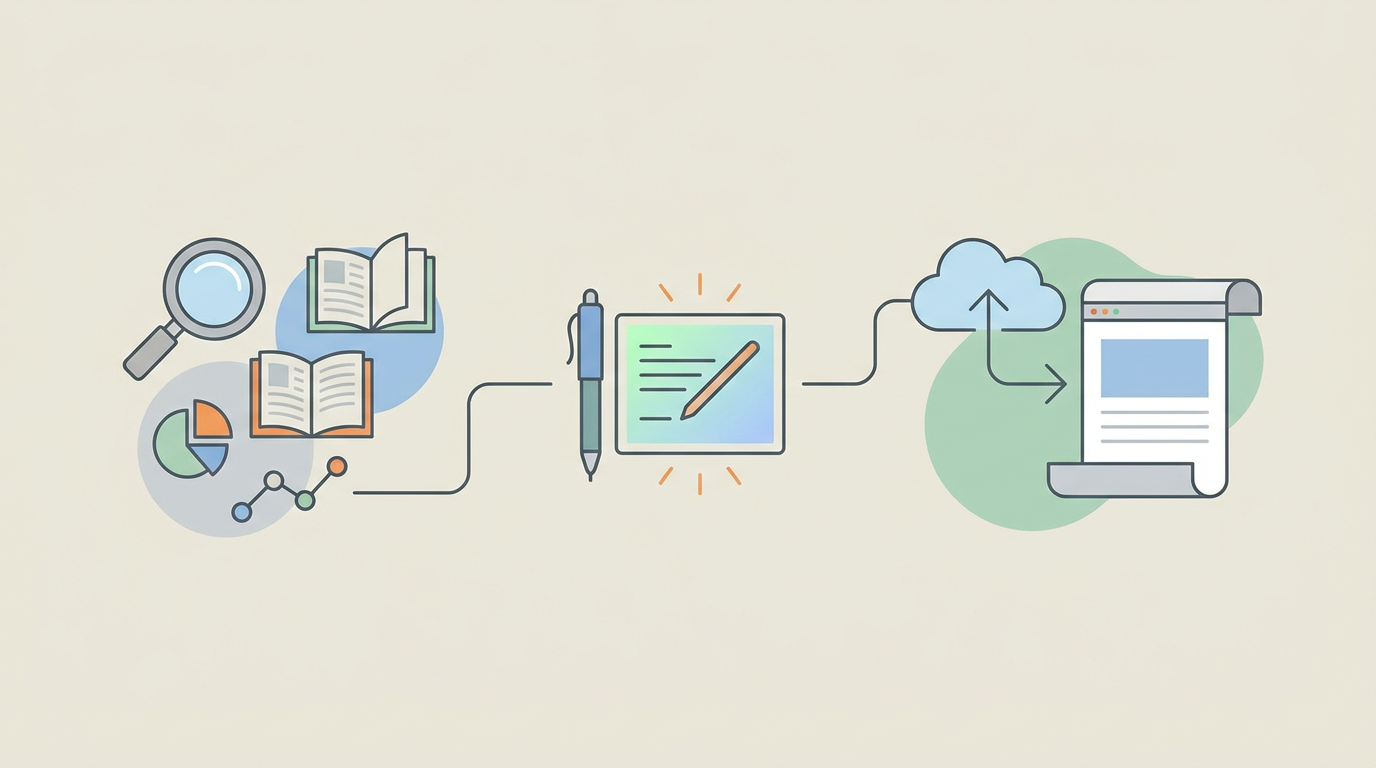
Rankdesk approaches the AI article generator as a complete publishing workflow rather than a blank text box. Research, writing, review, and publication need to work together.
Quick answer: How to use an AI article generator
Use this seven-step process to create articles that have a clear search purpose and are ready for editorial review:
- Define the audience, business goal, and primary search topic.
- Research the current results and identify what searchers need answered.
- Give the generator site, product, competitor, and keyword context.
- Generate a structured draft with a focused title and logical headings.
- Check facts, claims, links, examples, and search intent manually.
- Add original product knowledge and remove generic passages.
- Publish to WordPress or another supported platform, then measure performance.
The generator handles production. Your process still determines whether the finished page deserves to rank.
How an AI article generator works step by step
A useful AI article generator starts before the first sentence. It needs to understand the site, the subject, the intended reader, and what existing search results already cover. Without that context, it tends to produce a broad article that sounds acceptable but adds little.
Consider an online furniture retailer creating a guide at /guides/how-to-clean-a-linen-sofa. The target reader owns a linen sofa and wants to remove a stain without damaging the fabric. The commercial purpose is indirect: answer the care question, demonstrate product expertise, and give shoppers a reason to trust the retailer.
The initial draft might explain vacuuming, spot testing, blotting, and drying. That is a workable outline, but it misses several decisions a furniture specialist would catch. Is the cover removable? What does the care label say? Does the advice differ for water-based and solvent-only cleaning codes? A generator cannot safely guess those details.
Use the draft as a researched production layer. Then supply the operational knowledge that belongs to the business.
Google does not prohibit content merely because AI assisted with its creation. Its guidance focuses on whether content is useful and created for people, while its spam policies address scaled content abuse when pages are produced mainly to manipulate rankings. Quality control is therefore part of the workflow, not an optional polish pass.
How to brief an AI article generator
Start with the page outcome. Do not begin with a loose instruction such as “write a long article about sofa cleaning.” That prompt leaves the audience, depth, risk level, and commercial role unresolved.
For the linen sofa guide, specify that the reader is a homeowner dealing with a recent spill. Ask for safe first actions, care-label checks, cleaning-code explanations, common mistakes, and situations that require professional cleaning. State that the article must not recommend a universal cleaning solution because fabric treatments vary.
Next, provide business context. The retailer sells linen and linen-blend sofas, offers replacement covers for selected models, and has separate product care instructions. Those facts influence the internal links and caveats the page needs.
Competitor research should identify coverage gaps rather than sentences to imitate. Review how ranking pages structure the answer, which subtopics appear repeatedly, and where their advice becomes vague. Rankdesk explains this process in more detail in its guide to using AI-supported content production with competitor research.
A strong brief should also set boundaries. Prohibit unsupported durability claims, invented cleaning instructions, and statements that conflict with product care labels. These constraints prevent expensive edits later.
How to review AI-generated articles before publishing
Read the draft in the order a customer would use it. For a cleaning guide, incorrect sequencing can cause damage even when each individual instruction sounds plausible. The care-label check must come before applying moisture or a cleaning product.
The first version of our example places a homemade detergent recipe near the top. That is the failure mode. The retailer cannot confirm that recipe is safe for every linen blend, dye, or protective treatment, so the passage should be replaced with a direction to follow the manufacturer’s care instructions and spot-test any approved method in a hidden area.
Then review the page at four levels. Confirm that the main question is answered quickly. Check every factual statement against product documentation or a primary source. Replace generic examples with details the business can support. Finally, inspect the title, headings, internal links, and call to action.
Do not force a keyword into every heading. Search engines need clear topical signals, but repetitive phrasing makes the page harder to read. Google’s Search Essentials provide the baseline technical and content requirements for appearing in search results.
For a fuller editorial process, use the practical workflow for automating SEO content creation alongside your brand and legal review requirements.
How the Rankdesk AI article generator publishes to WordPress
Doing the process manually usually means moving between a keyword tool, competitor tabs, a document editor, an approval thread, and WordPress. Each handoff creates another place for formatting, links, or instructions to be lost.
Inside Rankdesk, the workflow begins with research into your site, competitors, and relevant keywords. That context feeds article or landing-page creation, so the draft is tied to the site rather than generated from an isolated prompt. The research, writing, and publishing features show how those stages fit together.
For the furniture retailer, the intended URL and topic become part of the plan. Rankdesk creates the search-focused article, while the editor checks the cleaning instructions against the retailer’s actual care documentation. The risky detergent recommendation is removed before approval, and model-specific links can be added where they are genuinely relevant.
Next comes publication. Connect a supported destination through the Rankdesk publishing integrations, including WordPress. Review the article when human approval is required, or use automatic publishing for content types where the team has already defined a reliable standard.
WordPress supports posts and pages through its official REST API documentation, which is the type of structured publishing layer that removes manual copying between systems. After publication, confirm the live URL, formatting, metadata, links, and indexability.
This walkthrough shows where Search Console fits after an article goes live and which reports help you assess search visibility.
Automatic publication saves time, but it raises the cost of a weak template or unchecked claim. Start with review required. Move selected content categories to autopilot only after several approved articles show that the research inputs, instructions, and output standards are stable. The AI content autopilot guide covers that transition in more detail.
How AI-generated articles can earn search rankings and assistant citations
An article does not earn visibility because it was generated quickly. It needs a crawlable URL, a clear answer, defensible information, and enough specificity to be useful as a source.
For the linen sofa page, short answer passages can define cleaning codes or explain why blotting is safer than scrubbing. Longer sections can cover exceptions, such as fixed upholstery and removable covers. These structures help readers extract the right instruction without stripping away necessary context.
AI assistants such as ChatGPT and Claude may cite pages they can discover and interpret, but no publisher can guarantee a mention. Improve the odds by using descriptive headings, consistent business information, primary sources, explicit product facts, and original guidance that is not copied from the current results.
The same principle applies to entity recognition. Make it clear who published the advice, what expertise supports it, and how the page relates to the rest of the site. See the practical guide on how to get mentioned by ChatGPT for a closer look at citations, entities, and source quality.
Compare AI article generator workflows
The right setup depends on publishing volume, editorial risk, and how much manual coordination the team can absorb.
| Workflow | Research input | Editorial control | CMS publishing | Best fit |
|---|---|---|---|---|
| Manual writing | Research collected by the writer | Full control at every stage | Copied and formatted manually | Sensitive topics and occasional articles |
| Standalone text generation | Prompt supplied for each draft | Review happens outside the tool | Usually manual | Teams that already have a separate SEO and publishing process |
| Rankdesk workflow | Site, competitor, and keyword research | Drafts can be reviewed before publishing | Supported automatic publishing, including WordPress | Recurring search-focused articles and landing pages |
Outrank and RankPill also serve teams evaluating automated SEO production. Compare current functionality, publication controls, integrations, and pricing directly with each vendor because those details can change. Rankdesk has also published a detailed Rankdesk and RankPill comparison focused on those buying criteria.
Common mistakes with an AI article generator
The most common mistake is scaling before defining an approval standard. If ten drafts repeat an unsupported claim, publishing faster only spreads the problem across more URLs.
Another mistake is treating word count as depth. A 2,000-word page can still avoid the exact decision the reader needs to make. For the sofa guide, the cleaning-code distinction is more valuable than several paragraphs describing why linen is popular.
Watch for keyword overlap too. Generating separate pages for “clean linen sofa,” “linen couch cleaning,” and “how to wash a linen sofa” may create three weak URLs targeting the same need. Consolidate them unless the search intent or product context is genuinely different.
Finally, do not automate measurement out of the process. Check whether the page is indexed, which queries generate impressions, whether the title matches those queries, and where readers move next. Use those findings to improve the brief for the next article.
AI article generator FAQ
Can an AI article generator create content that ranks on Google?
It can produce a strong draft, but ranking depends on more than generation. Search intent, factual accuracy, site authority, internal linking, crawlability, competition, and the usefulness of the final page all matter. Treat the generator as part of an SEO system rather than a ranking guarantee.
Can I publish AI-generated articles automatically?
Yes, if your platform is supported and the content category has a dependable review standard. Rankdesk supports automatic publication to platforms including WordPress. Begin with manual approval for several articles, record recurring edits, and update your instructions before removing that checkpoint.
Should every AI-generated article be edited by a person?
Human review is advisable for medical, legal, financial, safety-related, or product-specific claims. Lower-risk content can move toward automated publication after the team confirms that briefs, sources, formatting, and brand requirements are consistently followed.
Can an AI article generator make landing pages as well as blog posts?
Yes. A landing page needs a sharper commercial objective, tighter product evidence, and a call to action matched to the visitor’s intent. Avoid turning an informational article into a sales page by adding promotional language to every section.
How many articles should I publish each week?
Choose a pace your team can research, review, and maintain. Three accurate articles that support distinct search needs are more useful than dozens of overlapping pages. Rankdesk’s pricing and publishing options provide a practical reference when matching production volume to your plan.
If you want a more consistent way to research, create, and publish search-focused articles, see how Rankdesk supports the full workflow. It creates articles and landing pages from site, competitor, and keyword research, then lets you review them or publish automatically.
Start auto-writing for your site today
Create a free account, connect your site and generate your first article in minutes. No credit card needed.