
How to Get Mentioned by ChatGPT: A Practical Content and Entity Guide
August 14, 2026
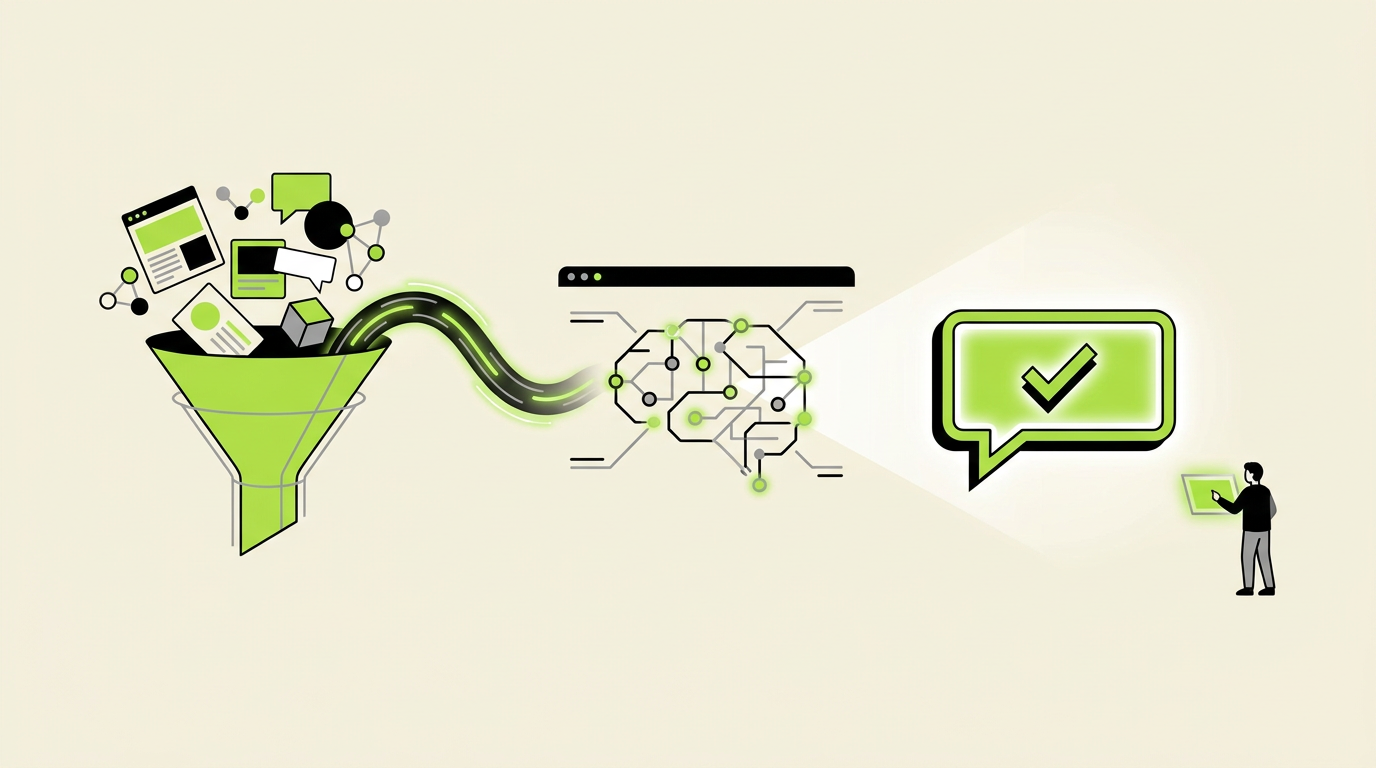
A prospect asks ChatGPT for the best solution in your category, but your company is absent from the answer. Your site ranks for several related searches, publishes regularly, and explains the product clearly, yet better-known or better-documented brands receive the mentions.
There is no submission form or markup that guarantees inclusion. You can, however, make your company easier to crawl, identify, verify, and cite. Rankdesk approaches this as a research and publishing problem rather than a prompt-writing trick.
Quick answer: how to get mentioned by ChatGPT
Use this workflow to improve the chance that ChatGPT can find and confidently reference your brand:
- Allow relevant crawlers in robots.txt and remove technical barriers from important public pages.
- Define your company and product entities with consistent names, descriptions, relationships, and structured data.
- Publish original evidence that gives other sites and AI systems a reason to cite you.
- Answer specific category questions in clear, extractable formats supported by concrete details.
- Build topical depth across product, educational, comparison, methodology, and support pages.
- Earn independent citations from credible publications, directories, partners, and expert sources.
- Keep facts consistent and current wherever your company is described online.
- Test prompts and referral data regularly, then fix gaps in coverage, evidence, or entity clarity.
We will carry one fictional example through the process. Acme Payroll sells payroll compliance software at example.com. Its target is to appear when someone asks ChatGPT for payroll tools that help US companies manage multi-state tax registrations. The company has a product page, a few broad blog posts, and no original research.
How ChatGPT finds and mentions sources
ChatGPT does not rely on one fixed directory of approved brands. Depending on the product feature, model, query, and user settings, a response may draw from model knowledge, retrieve current web pages, or use sources reached during a user request.
OpenAI documents separate controls for GPTBot, OAI-SearchBot, and ChatGPT-User in its official crawler documentation. These agents serve different purposes. A site owner should not assume that seeing one in server logs means every ChatGPT experience can access or cite the site.
A mention can also take several forms. ChatGPT might name a company without a link, cite a page in a web-search response, quote a fact, or recommend a category of products that includes the brand. Track these outcomes separately. A linked citation shows which page supported a current response, while an unlinked mention may be based on broader information that is harder to attribute.
Prominence helps, but recognition is not purely a popularity contest. A smaller company can become a useful source when it publishes the clearest primary evidence for a narrow question. Acme Payroll is unlikely to become the definitive source for all payroll software immediately. It can become a strong source for multi-state registration workflows if it documents that subject better than generic software roundups do.
Make your site crawlable for ChatGPT
Start with access. A useful article cannot contribute to a retrieved answer if a relevant crawler receives a block, an error, an empty client-rendered shell, or a login page.
Review the robots.txt file at the root of the domain. Robots.txt follows a standardized protocol described in RFC 9309, but it is an access instruction for compliant crawlers, not a security control. Keep confidential material behind authentication. Do not depend on crawler directives to protect it.
Check the exact user agents in OpenAI's current documentation before changing rules. Policies and agent names can change. A broad block against all automated agents may prevent access you actually want, while an unrestricted policy may conflict with legal or operational requirements. Make the choice deliberately.
Then inspect what the crawler receives. Fetch the public URL without logged-in cookies. Confirm that the primary heading, body copy, author or company attribution, publication date, and cited evidence appear in the returned HTML or are reliably rendered. Important facts should not exist only inside an interactive calculator or a script that fails when browser resources are limited.
Use this audit table for every page intended to support a mention:
| Site element | What to verify | Practical test | Common failure |
|---|---|---|---|
| robots.txt | Relevant crawler is not unintentionally blocked | Test the full URL against the applicable user-agent rule | A wildcard disallow covers the entire article directory |
| HTTP response | Canonical page returns a stable 200 response | Fetch with cookies disabled and follow redirects | Redirect chain ends at a regional or login page |
| HTML content | Main claims and context are available in readable text | Compare raw response, rendered page, and visible copy | JavaScript shell contains no meaningful article text |
| Canonical tag | Preferred URL points to the correct indexable page | Inspect the final page source | Canonical points to an old template or staging domain |
| Internal links | Relevant pages can be reached through ordinary links | Crawl from product and topic hub pages | Orphan articles exist only in the XML sitemap |
| Update signals | Dates, revised facts, and ownership are clear | Check page copy and structured data | An old date remains after material claims change |
Acme Payroll discovers that example.com/guides/multi-state-registration loads its state selector through JavaScript. The page source contains a title and empty container, while the detailed registration guidance appears only after an API request. The fix is to publish the core explanation in the page HTML and keep the selector as a useful enhancement.
This does not mean every page must be plain text. Interactive tools can attract links and help users. Give their inputs, methodology, limitations, and key outputs a stable textual home.
For a concise explanation of crawling, indexing, and serving, this Google Search Central video provides a useful technical foundation that also helps when diagnosing access problems for other retrieval systems.
Give ChatGPT clear entity information
An entity is the identifiable company, person, product, place, or concept behind a name. Ambiguity grows when a product and company share a generic name, descriptions vary by page, or third-party profiles place the business in conflicting categories.
Create one canonical company description that answers basic factual questions: the legal or public brand name, what the company makes, who it serves, where it operates, and how the product relates to the parent company. Use that description as a reference, not as text to paste identically across every page.
Acme Payroll currently calls itself a payroll platform on its homepage, a workforce finance system on LinkedIn, and an HR automation suite in directory listings. Those descriptions overlap, but they create uncertainty about the primary category. The company chooses “multi-state payroll and tax registration software for US employers” as its central description. Broader capabilities can still appear elsewhere.
Add an accessible About page, contact information, editorial ownership, and author or reviewer profiles where expertise matters. Product pages should state who provides the product instead of relying on a logo to communicate ownership.
Structured data can express these relationships in a machine-readable form. Use Organization markup for the company, Product or SoftwareApplication markup where appropriate, and Person markup for real authors. Google's structured data guidelines are written for Google Search features, but their rules about visible, accurate, representative information are sound implementation discipline.
Do not use markup to make claims that the visible page does not support. Do not list publications, awards, ratings, or corporate relationships merely because the schema vocabulary permits them. Structured data clarifies facts. It does not validate false or unsupported ones.
Use stable identifiers and sameAs references carefully. Link only to profiles that genuinely represent the same organization. If a directory has the wrong category or an abandoned social profile has obsolete branding, correct it before presenting it as corroboration.
Publish original evidence worth mentioning
Rewritten explanations rarely become preferred sources. If ten sites repeat the same general statement about payroll compliance, ChatGPT has little reason to associate the claim with the newest article.
Original evidence gives the page a distinct informational role. It can include a documented dataset, benchmark, experiment, expert analysis, public-record compilation, product methodology, or detailed operational example. Evidence does not need to be a large annual report. It does need to be reproducible enough that a careful reader can understand where the result came from.
For Acme Payroll, the useful project is not “The Ultimate Guide to Payroll.” It is a maintained matrix of state registration requirements for remote employers. The page records the responsible agency, registration trigger, required account, official source, date checked, and known exception for each state.
The company should explain its process beside the matrix:
- Which employer scenarios are included and excluded
- Who reviewed the information and their relevant role
- When each state record was last verified
- How conflicting agency instructions were resolved
- Where readers can report a correction
- Why the material is educational rather than legal advice
That method turns a table into attributable research. Without it, the page is another unexplained compilation.
Keep primary evidence close to the claim. If a page states that a particular state requires registration before the first payroll run, cite the state agency where possible and record the access date. Avoid citation chains in which your article cites a roundup that cites another blog that may once have referenced an official page.
Updates also matter. A page labeled “updated” after changing only its introduction is less trustworthy than a page with a revision log that identifies changed records. For facts with legal or financial consequences, visible maintenance is part of the evidence.
Structure content so AI systems can understand it
Clear formatting helps a retrieval system isolate the passage that answers a question. It also helps a human verify whether the passage applies to their situation.
Place a direct answer immediately under a specific heading. Follow it with scope, evidence, exceptions, and examples. Avoid delaying the answer through several paragraphs of category history. If the question is “When must a remote employer register for payroll tax in Colorado?”, start with the triggering conditions, not a definition of payroll.
Use descriptive headings, complete sentences, tables where attributes need comparison, and numbered steps where order matters. Define acronyms on first use. Label units and dates. State the jurisdiction. A percentage without a population, period, and method is difficult to reuse responsibly.
FAQs can cover natural follow-up questions, but they should not become a dumping ground for slightly altered keyword phrases. Each answer needs a distinct purpose. A product comparison page should define criteria and disclose the basis for each judgment rather than declare a winner through unsupported adjectives.
Programmatic landing pages require extra care. A template that changes only a city, industry, or integration name produces many URLs without adding much usable information. A strong local or category page includes unique requirements, relevant examples, product constraints, and links to source material. If those inputs do not exist, publish fewer pages.
This is where a disciplined automated SEO content workflow helps. Research, source selection, drafting, review, and publication need explicit checks so automation does not multiply factual ambiguity.
For Acme Payroll, each state page follows the same helpful structure but contains distinct substance. The California page explains agency accounts and filing responsibilities relevant to California. The Colorado page covers Colorado's rules. Both link back to the national methodology page, which defines how the records are maintained.
Build topical depth around the entities you want ChatGPT to associate with your brand

One excellent article can earn citations, but a coherent group of pages makes the site's expertise easier to establish and maintain. Topical depth means covering the decisions and evidence surrounding a subject, not producing every keyword variation a tool exports.
Acme Payroll builds a hub around multi-state registration. The hub links to the state matrix, a registration workflow, state-specific records, a glossary of agency account types, a methodology page, and a product page showing which parts of the process its software supports. Support documentation explains setup limits and required customer inputs.
Every page has a job. The educational pages explain the rules. The methodology page establishes evidence quality. The product page connects those rules to the software without pretending that product copy is neutral research. Support pages document operational detail.
Internal links should describe the relationship between pages. “See Colorado payroll registration requirements” is more useful than “learn more.” Add links from established product and guide pages, not only from newly generated articles. Orphaned clusters are difficult for crawlers and people to discover.
Depth also includes boundaries. State plainly when the product is not designed for a particular company size, country, or compliance model. Specific limitations improve entity clarity because they define what the product actually is.
Earn citations that support ChatGPT mentions
A company describing itself is one source. Independent organizations describing the same company provide corroboration.
Pursue citations where they make editorial sense: partner directories, professional associations, conference programs, expert interviews, public datasets, software integration listings, and publications that evaluate the category with a visible method. The goal is not to place the company name on hundreds of low-quality profile pages.
For Acme Payroll, the state matrix creates a legitimate outreach asset. Payroll consultants can reference it in client education. Remote-work publications can cite a state record. Accounting associations may use the methodology when discussing registration complexity. Those references are stronger when they point to the original evidence rather than a generic homepage.
Keep names and category descriptions consistent during outreach. If one partner calls the product an employer-of-record service even though it is payroll software, request a correction. A link with a materially wrong description can reinforce the wrong entity relationship.
Competitor comparison pages can contribute when they are factual and maintained. Compare declared features, publishing controls, integrations, audience, and workflow. Disclose the evaluation criteria and direct readers to vendors' own pricing pages for current numbers. Rankdesk applies that approach in its Rankdesk versus RankPill comparison.
Outrank and RankPill can be discussed as alternatives without turning a comparison into an attack page. Unsupported claims reduce trust. Precise differences are more useful to buyers and easier for other sources to reference.
How Rankdesk supports a mention-ready publishing workflow
Doing this manually requires continuity from research through publication. A brief can identify the right sources, yet those sources may disappear during drafting. A reviewed article can still fail if publishing strips links, headings, or metadata.
Rankdesk keeps the workflow connected. During onboarding, it researches the site, competitors, and keywords so planned topics reflect the existing business and its category. Users can review the process on the how Rankdesk works page.
Next, it creates search-focused articles and landing pages from that research. This is where a team should preserve the entity description, source requirements, and topic boundaries established earlier. The platform's research, writing, and publishing features are designed to keep those stages in one process rather than moving drafts among unrelated tools.
The user then reviews the output or chooses automatic publishing. Review remains useful for regulated subjects, original datasets, product limitations, and claims that require a named expert. Automatic publishing is better suited to approved formats with reliable source inputs and clear editorial rules.
Finally, Rankdesk can publish through supported destinations including WordPress, Shopify, and Lovable. Check the current publishing integrations against the site's stack before planning volume. Publication is not the end of the process. Teams still need to monitor crawl access, source freshness, corrections, and how pages are represented elsewhere.
This approach does not guarantee that ChatGPT will mention a brand. It removes avoidable breaks between topic research, structured writing, review, and publication. That matters when a site needs enough depth to establish an entity without sacrificing control over factual claims.
Measure whether ChatGPT mentions your brand
Prompt tracking is useful, but a single prompt is not a stable ranking report. Responses may vary by wording, model, location, available retrieval, and time. Record the conditions of every test.
Create a small prompt set based on real buyer tasks. Acme Payroll tests category discovery, state-specific research, product comparison, and implementation questions. It records whether the brand appears, whether a citation is present, which URL is cited, which competitors appear, and whether the description is accurate.
Do not repeatedly rephrase prompts until the brand appears and then report success. Use a fixed baseline and rerun it on a schedule. Add new prompts when customer research reveals a genuine use case.
Review server logs for documented OpenAI user agents, while remembering that access does not prove inclusion. Check analytics for referral traffic from ChatGPT and inspect the landing pages. Referral volume alone can miss unlinked mentions, so combine analytics with manual response reviews and brand monitoring.
When the brand is absent, classify the gap before publishing more pages:
- Access gap: the relevant URL cannot be reliably crawled.
- Entity gap: the system cannot clearly identify the company, product, or category.
- Evidence gap: competitors provide stronger original or independently verified material.
- Coverage gap: the site does not answer the specific task.
- Citation gap: useful claims exist but few credible third parties reference them.
- Freshness gap: the available information is outdated or contradictory.
Fix the identified gap. More volume is not a universal answer.
Common mistakes when trying to get mentioned by ChatGPT
Blocking every automated crawler by default is one mistake, but allowing access without understanding the policy is also careless. Separate security, training preferences, search visibility, and user-requested access decisions. Document who owns each decision.
Another failure mode is publishing hundreds of weak category pages. Automated blog publishing can maintain a useful cadence, yet it cannot supply missing evidence. If every page paraphrases the same five competitor articles, the site adds little that deserves attribution.
Do not hide the company behind clever branding. A homepage that never states the product category, customer, operator, or location forces readers and machines to infer basic facts. Put those facts in text.
Avoid fabricated authority signals. Anonymous expert quotes, unsupported statistics, invented survey findings, and misleading review markup create legal and reputational risk. If the dataset is small, state the sample. If a claim comes from product telemetry, explain what was measured.
Do not treat a ChatGPT mention as the only objective. The same work should help a buyer verify the company, understand the product, and make a decision. A cited page that sends readers to vague product copy has not completed the job.
FAQ about getting mentioned by ChatGPT
Can I submit my website directly to ChatGPT?
There is no general submission process that guarantees a website or brand will be included in ChatGPT answers. Make public pages accessible to the relevant documented crawlers, publish clear source material, and build independent references. For current behavior and crawler controls, use OpenAI's official documentation rather than third-party user-agent lists.
Does schema markup make ChatGPT mention a company?
No. Structured data can clarify entities and relationships, but it does not guarantee a mention or citation. The visible page must support the markup, and the underlying information still needs to be useful, accurate, accessible, and credible.
How long does it take to get mentioned by ChatGPT?
There is no dependable timetable. A current web-search response may discover an accessible page sooner than a model's broader knowledge changes. Publication, crawling, retrieval, citations, and model updates operate on different schedules. Track linked citations and general mentions separately.
Can a new website get mentioned by ChatGPT?
Yes, especially for a narrow question where the site provides strong primary evidence. A new brand will usually have fewer independent references, so it should focus on a specific subject, transparent methodology, clear authorship, and citations from relevant organizations.
Will more blog posts increase my chances of being mentioned?
Only when the additional posts improve coverage or evidence. Ten distinct state compliance records can strengthen a useful topic cluster. Ten rewrites of the same broad payroll article create duplication. Plan around unanswered customer decisions rather than a post quota.
Can I also use this process to get mentioned by Claude?
The principles carry over: clear public information, consistent entities, original evidence, independent citations, and readable page structure. Crawler controls and retrieval behavior differ by provider, so check Anthropic's current official guidance before changing technical access rules.
Should I mention ChatGPT repeatedly on my pages?
No. Repeating the product name does not make a page more likely to appear in an answer. Write for the underlying buyer question, identify your own entities accurately, and provide evidence that can be checked. Mention ChatGPT only when it is genuinely part of the topic.
If you want a more consistent way to research, write, and publish pages that make your expertise easier to find and verify, see how Rankdesk supports search-focused publishing. It creates articles and landing pages from site, competitor, and keyword research, with review or automatic publishing options.
Want articles like this on your site?
Rankdesk plans, writes and publishes SEO content for you. Start free and generate your first 3 articles.