
Rankdesk vs RankPill: Features, Publishing, Integrations, and Pricing
August 12, 2026

An SEO publishing tool can produce a polished article and still leave your team copying HTML, fixing headings, uploading images, and scheduling posts by hand. That last mile determines whether you have an automated publishing system or another writing interface.
Rankdesk and RankPill both address automated SEO production, but buyers need to compare the complete operating workflow rather than the promise of generated articles. Rankdesk publishes its supported integrations, entry price, and weekly posting allowance, which makes those details easier to verify before signup.
Quick answer: Rankdesk vs RankPill
Use this process to make the comparison without relying on feature-page language alone:
- Confirm whether each product is available to use now, not merely accepting signups or waitlist entries.
- Compare research and writing features using the same keyword, site, and article brief.
- Test whether publishing reaches your actual CMS without a manual copy-and-paste step.
- Verify that your specific CMS integration is live rather than planned or available through a workaround.
- Convert plan limits into your required weekly publishing cadence.
- Choose Rankdesk when you need documented WordPress, Shopify, or Lovable publishing with pricing from $39 per month for three posts a week; consider RankPill only after confirming its current availability, limits, and integration behavior inside the live product or checkout.
That final verification is important. Product launch posts, directory listings, and old screenshots are not reliable sources for current pricing or production readiness.
Rankdesk vs RankPill comparison table
The table separates details that can be verified on Rankdesk's current site from RankPill details that should be confirmed directly with its vendor. Unknown does not mean absent. It means the feature should not influence a purchase until you see it working or documented in current terms.
| Comparison point | Rankdesk | RankPill | What to verify before paying |
|---|---|---|---|
| Current availability | Publicly offered with product, workflow, integration, and pricing pages | Confirm current signup and account access directly | Make sure payment leads to a usable account rather than a waitlist |
| Core workflow | Research, writing, and publishing are presented as one workflow | Marketed around automated SEO production | Run one article from topic selection through CMS delivery |
| WordPress publishing | Listed as a live integration | Confirm current support and publishing method | Check post type, author, status, categories, links, and images |
| Shopify publishing | Listed as a live integration | Confirm current support | Check whether it creates native Shopify blog articles and handles formatting correctly |
| Lovable publishing | Listed as a live integration | Confirm current support | Ask whether publishing is direct and how routes or page files are handled |
| Entry pricing | From $39 per month | Check the vendor's current pricing page or checkout | Compare recurring price, included output, overages, and cancellation terms |
| Stated publishing allowance | Three posts a week on the advertised entry offer | Confirm the current plan limit and reset period | Distinguish generated drafts from successfully published posts |
| Workflow evidence | Dedicated pages explain features, integrations, and the path from onboarding to publication | Request a live product view if public details are incomplete | Do not treat a roadmap item as a live capability |
For the most current Rankdesk details, check the features covering research, writing, and publishing, then confirm the offer on the Rankdesk pricing page. RankPill pricing and limits can change, so inspect its own unlinked pricing or checkout pages immediately before making a decision.
How to compare Rankdesk and RankPill with one real workflow
A feature inventory becomes useful only when tied to a publishing requirement. Consider a fictional outdoor retailer called Northstar Trail, running its store on Shopify. The marketing team wants to publish three articles each week, including a guide targeting “how to size a hiking backpack.” The planned URL is northstartrail.com/blogs/field-notes/how-to-size-a-hiking-backpack.
The team already has product pages for 35-litre, 50-litre, and 65-litre packs. A useful article should explain torso measurement, carrying capacity, and fit checks while linking to the appropriate collections. It must not claim that one pack size works for every trip. It also needs to appear in Shopify with a clean title, headings, internal links, and the correct publication status.
Run that exact assignment in both products. Do not give one tool a detailed brief and the other a six-word prompt. Keep the target phrase, audience, site, desired URL, source material, internal links, and publication setting consistent.
Record where a person intervenes. If an editor must copy the result into Shopify, rebuild links, remove unsupported statements, or correct malformed headings, note the time and risk rather than declaring the workflow automated.
The Northstar Trail example also exposes a common measurement error. Generating three documents is not equivalent to publishing three usable posts. The relevant output is the number of articles that reach the right destination in acceptable condition.
Rankdesk vs RankPill features for research and writing
Both products sit in a category that combines topic research with AI-assisted writing. Feature names alone reveal little. “Keyword research” might mean anything from suggesting related phrases to building a site-specific publishing plan with clear topic boundaries.
For Northstar Trail, inspect the proposed angle before evaluating the prose. A weak system may create separate articles for “hiking backpack sizing,” “choosing backpack size,” and “what size hiking pack do I need?” Those pages could compete for the same intent. A stronger plan recognizes the overlap and assigns one authoritative guide, then reserves separate pages for materially different needs such as ultralight daypacks or multi-day expedition packs.
Article structure deserves the same scrutiny. The backpack guide should introduce the decision quickly, explain torso measurement before discussing capacity, and connect pack volume to trip length without pretending volume is the only variable. Product links should help readers act. Random links inserted because anchor text happens to match are not useful.
Check factual restraint as well. AI can write a plausible measurement instruction that does not match the retailer's actual fitting process. Give each product the store's approved fitting notes and see whether the article follows them. If the tool cannot accept or use business-specific source material, plan for a deeper editorial pass.
Search visibility also depends on basic technical and content policies. Google's Search Essentials explains the baseline requirements for eligibility and warns against practices intended to manipulate rankings. Automated production does not remove those obligations.
This short explanation of how search systems retrieve and rank information provides useful context for judging whether a tool produces genuinely useful pages rather than keyword-shaped text.
No platform can guarantee that an article will rank or be mentioned by ChatGPT, Claude, or another answer system. Treat guaranteed visibility claims cautiously. A platform can help produce crawlable, well-structured, useful material, but it does not control indexing, ranking, citations, or model responses.
Rankdesk vs RankPill publishing workflows
Publishing is where superficially similar products separate. Ask each vendor to show the transition from approved article to live CMS entry. A button labelled “publish” is not enough if it exports a file or sends text to an intermediate queue that your team must process.
In the Northstar Trail test, follow the article into Shopify. Confirm that the title lands in the title field, the body keeps valid heading hierarchy, links point to the intended collection URLs, and the blog assignment is correct. Then check whether the article is a draft, scheduled item, or immediately public page.
Publication status matters because different teams need different controls. A small operator may want direct publication to remove routine work. A regulated company may require review before anything becomes public. Neither model is universally better, but the product must make its behavior clear.
Failures are often mundane. A heading can arrive as bold paragraph text. Relative links can break. An image may lack alternative text. A post may publish under the wrong author or default blog. These issues create rework across every article, so test field mapping rather than judging one clean preview.
WordPress buyers should ask whether publishing uses supported platform interfaces and how authentication is handled. The official WordPress REST API documentation shows the content resources and authentication considerations involved in programmatic publishing. You do not need to inspect every request, but the vendor should be able to explain how posts reach your site and what permissions are required.
Rankdesk explicitly positions publishing as part of the product rather than an export step. Its workflow from onboarding to published article is the most relevant page to inspect before starting a production test. For RankPill, request the same end-to-end demonstration in the currently available product.
Rankdesk vs RankPill integrations: live support or planned support
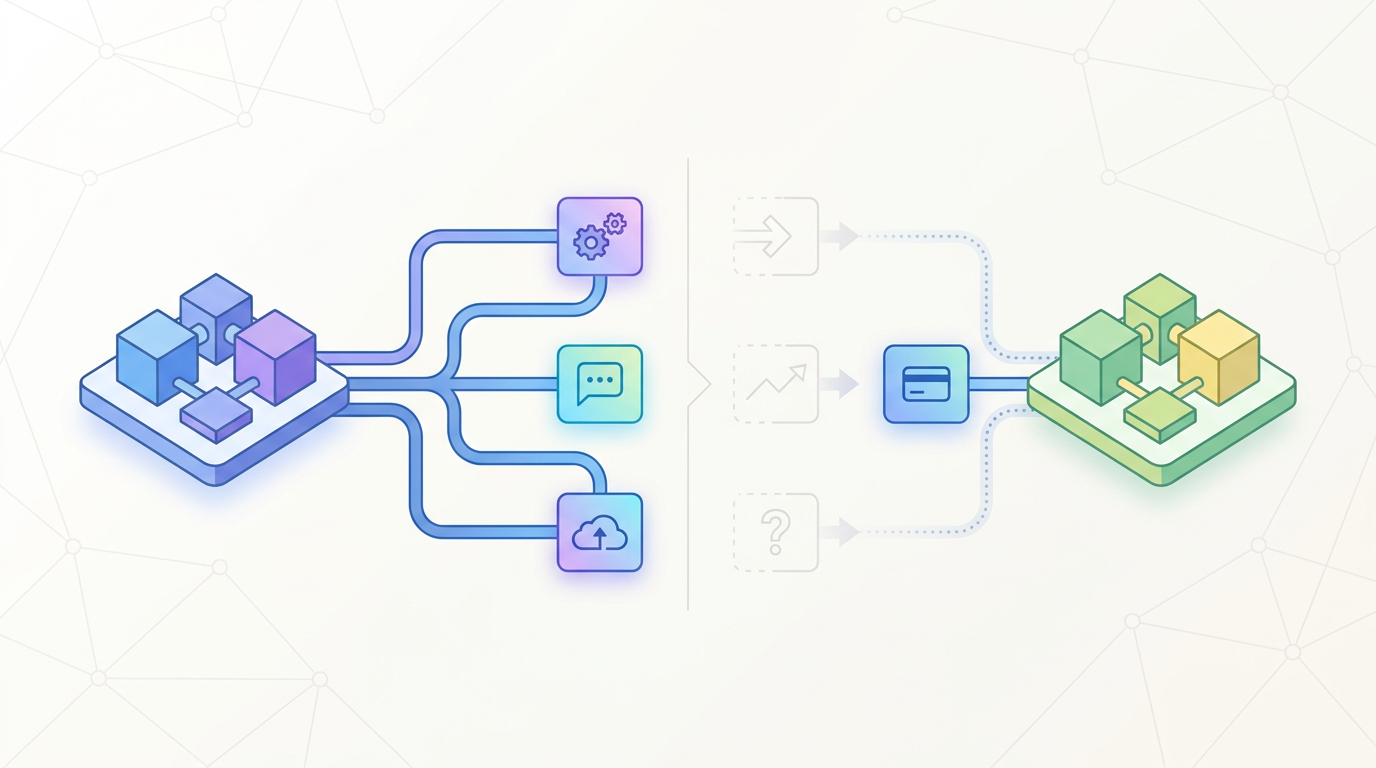
Integration lists need dates and status labels. “Supports Shopify” should mean a paying user can connect a store and publish an article now. It should not mean that a Zapier recipe exists, an API may make the connection possible, or the feature appears on a roadmap.
Rankdesk currently lists WordPress, Shopify, and Lovable on its publishing integrations page. That combination covers a conventional CMS, an ecommerce platform, and a common application-building workflow. Buyers using one of those destinations can test a named path instead of designing their own transfer process.
RankPill should be assessed against the same standard. Confirm the destination, authentication method, fields transferred, publication states, and whether the integration is generally available. If access depends on a private beta, manual setup, or a higher plan, include that constraint in the comparison.
For Northstar Trail, generic Shopify support is only the first check. The team should confirm which blog receives the article, whether existing store links can be selected or supplied, and what happens when the CMS rejects a request. Retry behavior matters. Without a visible failure state, a dashboard can report completion while the store has no new article.
Lovable creates a different test. Publishing a page into a code-oriented site is not the same operation as creating a WordPress post. Ask how routes, page templates, metadata, and subsequent edits are handled. Choose based on your actual destination rather than the integration count printed on a comparison page.
Rankdesk vs RankPill pricing and plan limits
The advertised Rankdesk entry point is $39 per month for three posts a week. That is a cadence-based allowance, which makes it easy to compare with Northstar Trail's target of three weekly articles. Check the current pricing page before purchase because offers and plan terms can change.
Do not convert weekly limits into an assumed monthly total without reading the billing rules. Some months contain more publishing days than others, and platforms may define usage by calendar week, rolling period, or billing cycle. Ask what happens to unused capacity and whether a failed publication consumes an allowance.
RankPill's current price and output limits should be taken from its live checkout or account terms at the moment of evaluation. Do not rely on a launch announcement, social post, software directory, or an old comparison article. If the vendor shows monthly article credits, convert them into the same weekly operating target before comparing cost.
For example, Northstar Trail needs 12 articles during a four-week campaign. The buyer should calculate the cost of 12 completed and published Shopify articles, not the cost per generated draft. Add expected editorial time, CMS handling, failed-post recovery, and any integration surcharge.
A cheaper generation allowance can cost more operationally when every article needs 20 minutes of formatting. The opposite problem also occurs: a highly automated plan may publish too quickly for a team that cannot review claims and links. Set the required review model first, then compare the plans that support it.
Ask whether limits apply separately to research, generation, revisions, and publication. Regenerating a section should not be assumed free. Also check whether connecting multiple sites changes the plan requirement, especially for agencies or operators with several storefronts.
How Rankdesk handles the workflow from topic to publication
A manual workflow usually spreads work across a keyword tool, brief document, writing interface, editor, and CMS. Rankdesk is designed to remove transfers between those stages. This is where its positioning becomes more concrete than a list of AI features.
The user begins with onboarding and site context. That gives the system a destination and a business to write for, rather than treating every article as an isolated prompt. For Northstar Trail, the relevant context is an outdoor retail site on Shopify with existing backpack collections and a field-notes blog.
Research and planning come next. The proposed article needs a distinct search intent and a place within the site's existing coverage. The backpack-sizing guide should not duplicate a collection page or split one intent across several near-identical posts.
Rankdesk then handles article production. The editor still needs to examine business-specific claims, product references, measurements, and internal links. Automation reduces repetitive assembly, but it does not transfer responsibility for accuracy away from the publisher.
Finally, the article moves to the connected publishing destination. For this example, that means Shopify rather than a downloadable document waiting in a folder. WordPress and Lovable users follow the corresponding supported route. The practical benefit is fewer handoffs: research, writing, and delivery remain parts of one operating sequence.
The practical workflow for automating SEO content creation explains how to preserve review standards while reducing repetitive production work. It is useful if you are deciding which steps should remain manual before configuring either product.
This does not mean Rankdesk is the right choice for every buyer. A team using an unsupported CMS may need another platform or a custom publishing layer. A company requiring legal approval before every draft goes live must also verify that the available workflow matches its governance process. Buy for the workflow that exists, not the workflow you hope to adopt later.
Common mistakes in a Rankdesk vs RankPill trial
The first mistake is testing only the writing screen. Many products can create a readable article from a broad prompt. The costly differences appear in topic selection, source handling, internal linking, field mapping, and publication recovery.
Another mistake is giving the trial a disposable keyword. Use a topic that you genuinely intend to publish and that requires knowledge of your products or services. Northstar Trail's backpack-sizing topic works because the article needs approved measurement guidance, links to existing collections, and a defined Shopify destination.
Do not score output by word count. A 2,500-word article can be less useful than a 1,200-word page if it repeats advice, invents claims, or postpones the answer. Review whether the article resolves the searcher's decision and supports the site's commercial path without turning every paragraph into a sales pitch.
Availability can also be misread. Access to a landing page, demo, or payment form does not prove that every advertised integration is enabled in the account. Connect a real test site with restricted permissions and publish a draft. Remove the connection afterward if you do not continue.
Finally, teams often ignore maintenance. Open the published article in the CMS, make a small correction, and observe where future edits should happen. Ask whether republishing overwrites manual changes. That behavior becomes important when product details, links, or recommendations change six months later.
Rankdesk vs RankPill for different buyers
Rankdesk is the clearer candidate when your site uses WordPress, Shopify, or Lovable and you want a disclosed route from research through publishing. The published entry offer also gives small teams a concrete starting point: $39 per month for three posts each week, subject to the current terms on the pricing page.
RankPill may still merit a trial if its current product supports your CMS, review process, output requirement, and budget. Require evidence inside a live account. A marketing claim that sounds equivalent to Rankdesk should not be treated as operationally equivalent until the same test article reaches the same destination.
Agencies need additional checks. Confirm how many sites can be connected, whether client accounts stay separated, and how usage is allocated. Neither a low headline price nor a large article allowance is useful when the plan supports only one destination and the agency manages ten.
Teams seeking programmatic landing pages should be especially careful. Blog publishing and large-scale page generation involve different templates, URL rules, structured inputs, quality controls, and duplicate-content risks. Do not assume that a blog workflow can safely create hundreds of location or category pages. Ask for a demonstration using the exact page type you need.
If you want to understand why Rankdesk treats publication as a core product function, the company's explanation of why it built an SEO system that publishes provides the relevant product rationale. The decision still comes back to your production test.
Rankdesk vs RankPill FAQ
Is Rankdesk better than RankPill?
Rankdesk is the stronger documented option for buyers who need WordPress, Shopify, or Lovable publishing and want a public starting price with a stated weekly cadence. RankPill could be suitable if its current account proves the integrations, controls, limits, and availability you require. Run the same article through both before treating feature labels as equivalent.
How much does Rankdesk cost?
Rankdesk advertises plans from $39 per month for three posts a week. Check the current Rankdesk pricing and plan details for billing terms and any changes before subscribing.
Can Rankdesk publish blog posts automatically?
Rankdesk is built around research, writing, and publishing, with listed integrations for WordPress, Shopify, and Lovable. Test the desired publication status and CMS field mapping on a non-critical draft before enabling a regular schedule.
Does RankPill publish directly to WordPress or Shopify?
Verify this in RankPill's current product or with a live vendor demonstration. Ask to see a newly generated article arrive in the CMS, then inspect title, body, links, images, author, category, and status. A logo on an integration list is weaker evidence than a completed test publication.
Can either tool guarantee mentions in ChatGPT or Claude?
No responsible platform can guarantee that an independent answer system will mention a specific brand. Useful, accessible, well-supported pages may improve the source material available to search and answer systems, but inclusion depends on systems the publishing tool does not control.
Are these tools suitable for programmatic SEO pages?
Only if the product supports structured page inputs, controlled templates, unique value at scale, URL management, and the required publishing destination. A system designed for recurring blog articles should not automatically be assumed suitable for hundreds of landing pages.
Which product should a Shopify store choose?
Start with Rankdesk if direct Shopify publishing, a three-post weekly cadence, and a publicly documented workflow match the store's needs. Test one real article, including internal collection links and the correct Shopify blog assignment. Choose RankPill only if it demonstrates an equal or better live workflow under current plan terms.
For a buyer who values verifiable availability over promised capability, the practical choice is straightforward. Use Rankdesk when its supported destinations and publishing cadence fit your operation. Keep RankPill in the evaluation only when its live product can complete the same end-to-end test without hidden manual work. Read next: Rankdesk vs Outrank: Features, Integrations, Publishing, and Pricing.
Want articles like this on your site?
Rankdesk plans, writes and publishes SEO content for you. Start free and generate your first 3 articles.