
AI Blog Writing for Lovable: How Automated Publishing Works
October 12, 2026

A Lovable site can launch quickly, yet its organic growth can stall when the blog has no repeatable publishing process. Drafts remain in documents, subject experts cannot review them in time, and pages go live without a clear keyword or internal-linking plan.
An AI blog writer for Lovable gives the workflow a home from research through publication. Rankdesk supports this process by preparing search-focused articles for review and sending approved articles into a Lovable site through its live integration.
Quick answer: how to publish SEO articles to Lovable
Use this workflow to create and publish articles consistently:
- Choose a topic tied to a service page, product category, or customer question.
- Research the query, competing pages, site context, and search intent before drafting.
- Create a brief with the reader, angle, evidence needed, and internal links.
- Generate the article, then add firsthand expertise, accurate claims, and a clear next step.
- Review the draft for factual accuracy, page structure, links, metadata, and brand voice.
- Approve the finished article and publish it to your Lovable site through the live integration.
- Submit the URL for indexing, track impressions and clicks, and refresh the page using search data.
How an AI blog writer for Lovable supports SEO goals
Publishing more frequently only helps when each page has a defined job. A useful article can answer an early-stage question, explain a comparison, support a commercial page with internal links, or document expertise that readers and AI assistants can cite.
Start with the page you want the article to support. For example, a financial software company might want more qualified visitors for /expense-management. Its blog topic, “How to build an expense approval workflow for a 50-person company,” can answer a practical question while linking readers to that solution page where relevant.
This approach creates topical coverage around products and services instead of a collection of disconnected posts. It also gives writers a decision framework. An article earns a place on the site when it serves a real query and supports a useful next action.
Google’s Search Essentials emphasize helpful, reliable, people-first content. Build every brief around the reader’s task and the evidence required to answer it well.
A worked example: building a Lovable resource hub
Imagine a B2B expense management startup with a Lovable marketing site. The team has a product page at /expense-management and plans a resource hub at /resources.
The first proposed post is “Expense policy examples for distributed teams.” During research, the team sees that generic templates dominate the results. They adjust the angle: include approval thresholds, receipt rules, reimbursements, and policy exceptions for contractors. A finance lead supplies the company’s real decision criteria, while the editor removes claims that lack a source.
The final post links to /expense-management once in the section on approval workflows and links to a related guide on reimbursement timelines. It avoids placing the same promotional link after every heading. Readers get a complete answer, and the product page receives a contextually relevant internal link.
How to plan Lovable blog topics before writing
A strong publishing workflow starts with a topic map rather than a blank prompt. Group ideas by the customer problems your product solves, then select topics with clear search intent and a credible angle from your team.
For the expense management example, the team could build three clusters:
- Expense policies: templates, approval rules, and reimbursement procedures
- Spend controls: budgets, virtual cards, and approval flows
- Finance operations: month-end close, receipt collection, and audit preparation
Prioritize one cluster at a time. This makes internal links easier to plan and helps Google understand the relationship between related pages. The guide to automated topic clusters, keyword mapping, and internal links shows how to turn that structure into a publishing plan.
Keep a small brief for each article. Record the primary question, intended reader, supporting product page, sources to consult, and facts that require subject-matter review. This prevents vague drafts and gives reviewers a clear scope.
How to write articles that deserve approval
An AI draft can accelerate production, while editorial review protects accuracy and usefulness. Give reviewers specific work to do. They should validate claims, replace generic examples, check that recommendations fit the audience, and confirm that the article reflects the current product.
In the example, the first draft recommends an approval threshold for all teams. The finance lead flags the issue: thresholds depend on purchase category, spend level, and company policy. The revised article uses a small decision framework instead of presenting one threshold as universal advice.
Use this pre-publication comparison when reviewing a Lovable article:
| Review area | Weak version | Approved version |
|---|---|---|
| Search intent | Broad overview of expense management | Direct answer to policy examples for distributed teams |
| Expertise | Generic recommendations | Finance-team rules and operational context |
| Internal links | Repeated product links | One relevant link to /expense-management and related resources |
| Claims | Unsupported statements about compliance | Specific, reviewed guidance with sources where needed |
| Page structure | Long blocks of text | Scannable headings, examples, and a practical template |
Check the title, heading hierarchy, URL, meta description, and links before approval. Add descriptive image alt text when images provide useful context. For eligible content types, Google’s structured data documentation can help your team assess whether markup fits the page, though markup requires accurate page information and valid implementation.
For a broader editorial process, read how to automate SEO content creation. The key control is a real approval stage with an accountable reviewer.
How Rankdesk publishes approved articles to Lovable
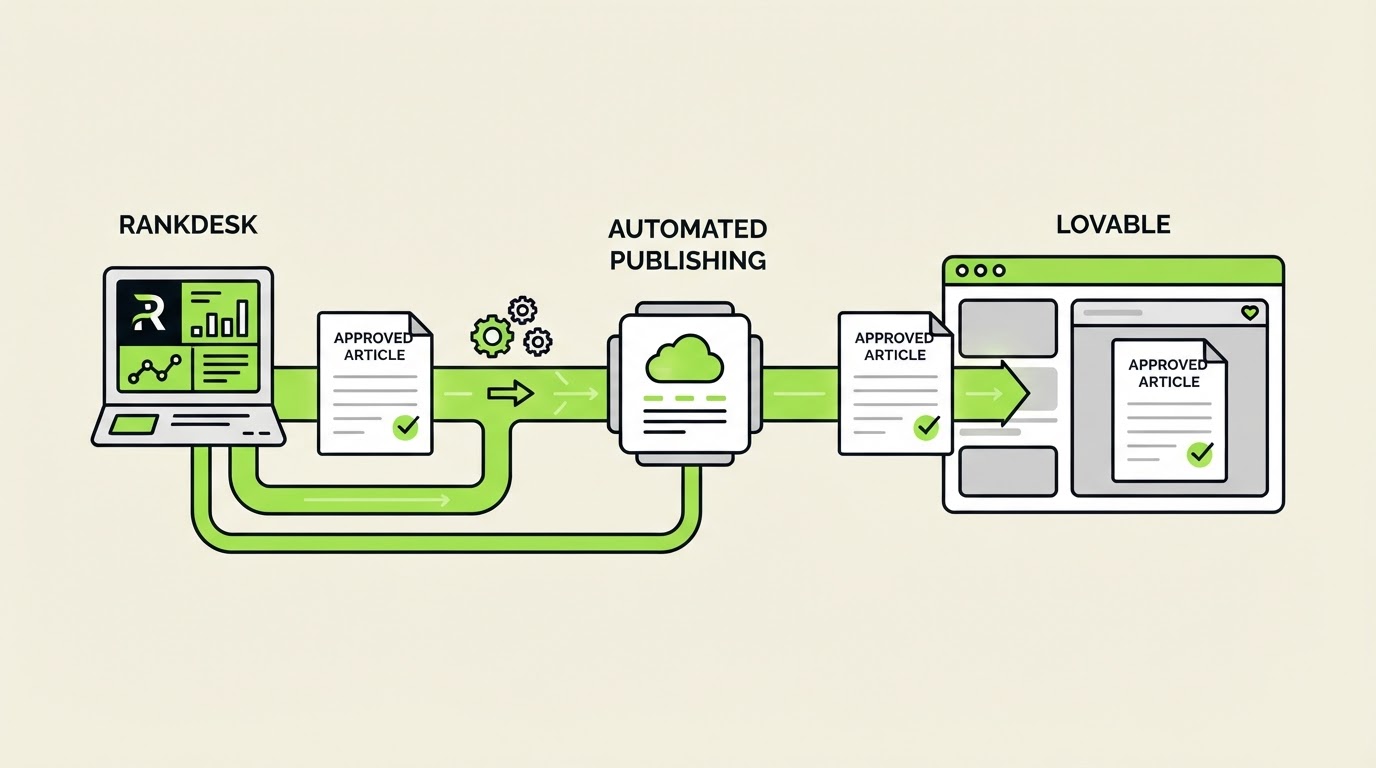
Manual copy-and-paste creates avoidable publishing errors: missing headings, broken links, inconsistent URLs, and drafts published before review. Rankdesk keeps the research, writing, approval, and publishing path connected, then uses its live Lovable integration to send approved work to the site.
Here is what the expense management team would do inside the workflow:
- The team selects the expense-policy topic and identifies
/expense-managementas the supporting page. - Rankdesk researches the site, relevant competitors, and keywords to shape the article brief and draft.
- The finance lead reviews the draft, replaces broad guidance with company-backed operational detail, and approves the final version.
- Rankdesk sends the approved article to the Lovable site through the live integration.
- The editor checks the published URL, confirms the resource hub link, and monitors performance after indexing.
See the Lovable integration for the supported publishing connection, and review how Rankdesk works for the wider research-to-publication process.
The workflow reduces administrative steps while keeping editorial judgment at the point where it has the most value. It also supports a consistent publishing cadence without asking a team to sacrifice review standards.
How to improve Google rankings and AI assistant citations from Lovable content
Search visibility grows when a site repeatedly provides clear answers, trustworthy details, and pages that connect logically. AI assistants draw from web content in different ways, so there is no guaranteed citation outcome. Your practical goal is to publish pages that are easy to understand, specific enough to reference, and supported by credible information.
For each article, write a direct answer near the opening. Define specialized terms, use concrete examples, identify the conditions behind recommendations, and attribute outside claims to authoritative sources. Product-led content also benefits from transparent About, contact, and policy pages that help visitors assess the company behind the guidance.
In the expense-policy example, the section on contractor reimbursements can state the conditions under which a team may use a separate policy. That is more useful than a broad statement that every contractor should follow the employee process.
Connect articles to core commercial pages, but preserve the reader’s experience. A resource article should stand on its own as a useful answer. For more detail on creating content that can surface in AI-driven answers, see how to get mentioned by ChatGPT.
Common mistakes when publishing AI-written articles to Lovable
The most common problem is treating publication as the finish line. A page needs measurement and maintenance after it goes live.
Avoid these failures:
- Publishing drafts without a subject-matter review for factual, legal, financial, or technical claims.
- Building every article around the same broad keyword and leaving topic gaps unanswered.
- Adding excessive promotional links that interrupt the answer.
- Reusing the same examples and introductions across several articles.
- Ignoring URLs that earn impressions but few clicks or receive no impressions after indexing.
Export the last 90 days of Google Search Console data and look for pages with high impressions and weak click-through rates. Improve titles and descriptions where the page already matches the query. For pages with impressions but low average positions, expand the sections that answer the searcher’s core question and add internal links from related articles.
Publishing volume has a trade-off. A team that can review two strong articles each month will usually build a healthier library than a team that releases many unreviewed drafts. The right cadence is the one your reviewers can sustain while adding real expertise.
FAQ
Can Lovable sites rank on Google?
Yes. Rankings depend on crawlable pages, useful content, technical implementation, relevant links, and the site’s overall quality signals. Publish pages with stable URLs, clear internal links, descriptive titles, and content that answers a real query. Use Google Search Console to monitor indexing and search performance.
Should every Rankdesk article publish automatically to Lovable?
Use automatic publishing for content that has an established brief, trusted source inputs, and a predictable review standard. Keep an approval stage for topics involving product claims, regulated advice, pricing, or sensitive company information. Rankdesk’s live integration supports publishing approved articles into Lovable.
How many blog posts should a Lovable site publish each month?
Choose a cadence your team can research, review, and maintain. Start with a focused cluster of a few high-value questions around one service or product area. Expand after you have a clear review process and performance data. This guide on publishing automation without losing quality explains the controls worth keeping.
Can an AI blog writer create pages that AI assistants cite?
It can help create and organize the underlying articles. Citations depend on the assistant, query, source selection, and the quality of available web content. Publish clear, accurate, evidence-backed pages with firsthand expertise, then keep them current as products and policies change.
If you want a consistent way to plan, write, review, and publish search-focused articles to a Lovable site, see how Rankdesk works. It researches your site, competitors, and keywords, then creates articles and landing pages your team can approve or publish automatically.