

Automatic Blog Post Generator
A blank content calendar creates pressure to publish quickly, and that pressure often produces thin articles, overlapping topics, and pages that never earn impressions. An automatic blog post generator should shorten the research-to-publication workflow while keeping decisions about intent, expertise, and quality visible.
Rankdesk helps teams research their site, competitors, and keywords before creating articles or landing pages for review or publication. The result depends on the workflow around the draft.
Quick answer: how to use an automatic blog post generator
Use this workflow to create blog posts that have a credible path to rankings:
- Choose one audience problem and map it to a search intent.
- Check existing URLs and search results before approving the topic.
- Build a brief with the reader, angle, evidence, internal links, and conversion goal.
- Generate a structured draft, then add firsthand details and verify claims.
- Publish to a reviewed WordPress category with metadata, links, and an author assigned.
- Review impressions, queries, and engagement after publication, then refresh pages with traction.
Start an automatic blog post generator with the right topic
A generator can produce a complete article in minutes. Topic selection determines whether that article serves a distinct search need or competes with a page already on your site.
Start with a practical content inventory. Export the last 90 days of query and page data from Google Search Console. Group pages by service, product category, customer question, and buying stage. Then compare the proposed topic against existing URLs, including older posts that receive few visits.
Google's guidance on creating helpful, reliable, people-first content supports the same approach: make each page useful to a defined audience and bring clear value beyond what appears elsewhere.
Consider a hypothetical plumbing company using WordPress. Its website already has /water-heater-repair/, a commercial service page, and a short post called /signs-water-heater-is-failing/. The team proposes a new article, "How much does water heater repair cost?"
That topic has a separate purpose. A reader needs price factors, repair scenarios, and a decision framework before booking service. The draft should link to the repair service page where appropriate, while the service page remains focused on scheduling help. During the review, the team discovers the old signs post repeats much of the new article's diagnosis section. They update the old post to focus on warning signs and link readers to the cost guide. This prevents two weak pages from covering the same ground.
For a fuller process covering research, drafting, and approval stages, see this guide to automating SEO content creation.
Build a brief before generating automatic blog posts
A useful brief gives the generator constraints that come from the business rather than generic web patterns. Write the brief before any draft exists.
For the plumbing example, the brief should state that the article serves homeowners comparing repair with replacement, covers variables that change an estimate, and avoids fixed prices unless the company can support them locally. It should include a clear next step: request an inspection from the water-heater repair page.
Add real source material wherever possible: service notes, approved pricing ranges, warranties, common customer questions, locations served, and input from the technician who handles estimates. Keep citations close to specific claims. This produces stronger material for Google and for AI assistants that look for direct, attributable answers.
Use this editorial comparison when choosing how much automation to apply:
| Workflow approach | Research input | Editorial control | Publishing speed | Best fit |
|---|---|---|---|---|
| Manual writing | Writer gathers sources and keywords | Full page-by-page review | Slow | High-stakes or highly technical topics |
| Generator-only drafting | A short prompt or title | Light review | Fast | Early ideas and internal drafts |
| Research-led automated workflow | Site context, keyword intent, competitor gaps, and a content brief | Review checkpoints for claims, links, and brand details | Fast with oversight | Ongoing SEO publishing programs |
The third approach gives a content team repeatable inputs without treating every topic as identical. Use the AI keyword research and content-writing workflow to turn groups of related questions into planned articles instead of isolated drafts.
Generate an article that answers the search intent
Ask the generator for a page structure, then assess whether each section earns its place. The plumbing cost guide needs an early explanation of the factors that affect an estimate: heater type, parts, labor complexity, access, code requirements, and replacement age. It also needs a short repair-versus-replace section and an inspection CTA.
Generic filler often appears when the brief lacks source material. Remove broad claims such as "regular maintenance is essential" unless the article explains the maintenance task, who performs it, and why it affects the reader's decision. Add a technician-approved example instead, such as a failed heating element on an electric tank unit versus a leaking tank that requires replacement evaluation.
Review every factual statement, especially health, legal, financial, product, and local service claims. Google's spam policies for web search explain the risks around scaled content created mainly to influence rankings. A reviewable, genuinely useful page provides a better standard for production.
Publish automatic blog posts in WordPress with quality checks
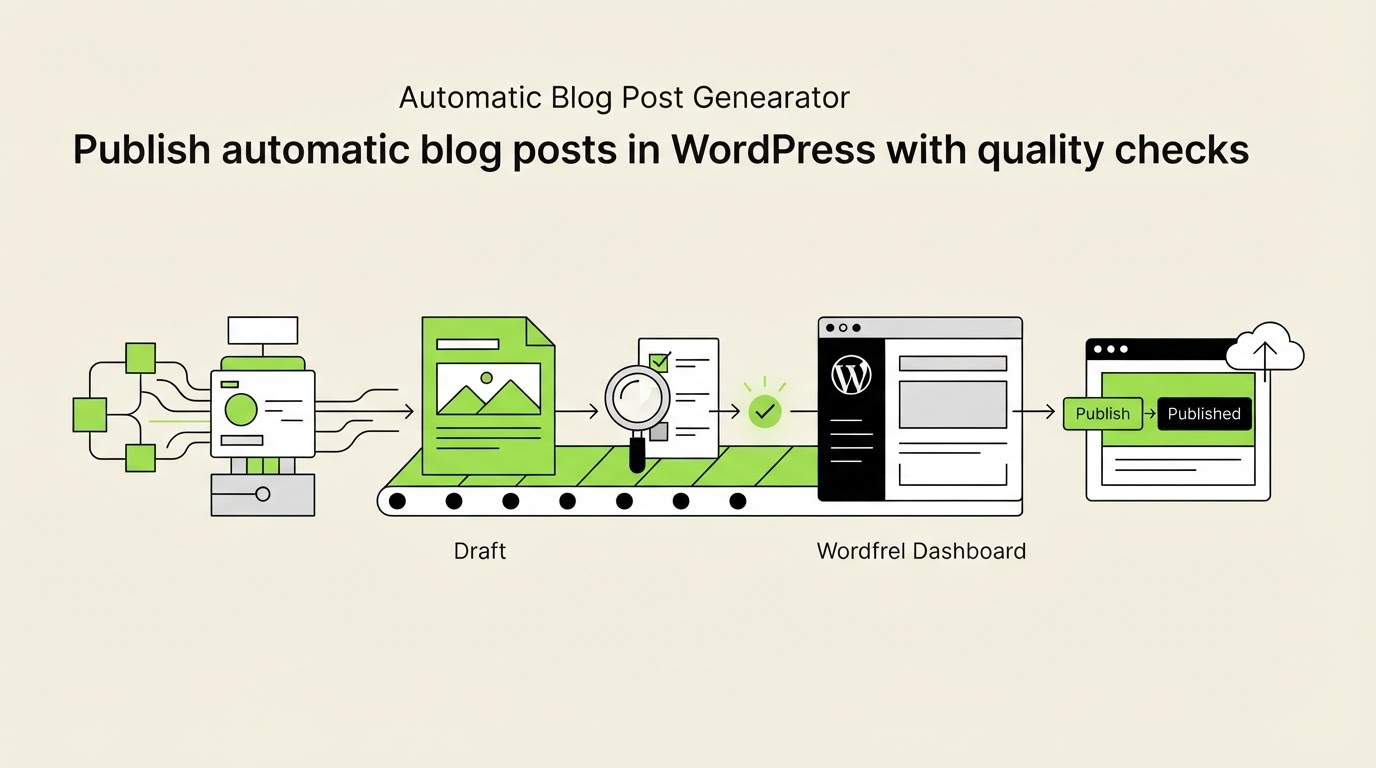
WordPress is a practical platform for regular SEO publishing because editors can manage authors, categories, drafts, media, and internal links in one place. Use an automatic blog post generator to prepare a well-structured draft, then maintain an editorial gate before publication.
For the plumbing example, assign the article to the water-heater category, write a specific title and meta description, and add links to /water-heater-repair/ and the older warning-signs post. Check the mobile layout, form placement, headings, image licenses, and every local claim. Publish the page as a draft first when a subject-matter review is needed.
Then request indexing through Search Console if the page is timely, while allowing normal discovery through internal links and your XML sitemap. Google explains how sitemaps help search engines discover URLs, although discovery and indexing still depend on Google's systems.
A useful WordPress program also supports AI search visibility. Write concise answer sections, name the entity behind the advice, use sources for claims, and connect related pages with descriptive links. These practices make it easier for systems such as ChatGPT and Claude to understand what the business offers and when its content applies. Read the practical guide on earning mentions in ChatGPT for a deeper treatment of entity coverage and citation-ready content.
How Rankdesk handles the automatic blog post workflow
A reliable process has several handoffs: research, planning, drafting, review, and publishing. Rankdesk keeps those steps connected instead of asking the team to reconstruct context in separate tools.
First, it analyzes the website, competitors, and relevant keywords to identify topics and page opportunities. Next, it creates articles or landing pages around the selected goal, giving the editor a starting point tied to the topic rather than a blank prompt. Teams can review drafts for business accuracy, adjust internal links and calls to action, then publish content automatically when their process supports it.
Explore the Rankdesk WordPress integration when WordPress is your publishing platform, or review the broader integrations page for supported options. Agencies managing many approval paths can also use the guidance for scaling client SEO content to set roles, templates, and publishing standards.
Measure results and refresh the pages that gain traction
Publishing starts the measurement cycle. Review search queries, impressions, clicks, rankings where available, and leads attributed to each article. Compare the page's initial query set with the intent stated in the brief.
In the plumbing example, the cost guide may start appearing for queries about repair cost, replacement cost, and electric water-heater repair. Add a focused section only when the query pattern fits the page's purpose. Create a separate article when the query reflects a different task, such as choosing tankless versus tank storage. That decision protects the original page's clarity.
Set a 60- to 90-day review window for new evergreen articles. Refresh weak introductions, missing questions, internal links, and outdated operational details. Preserve sections that already match user demand. The guide to publishing automatically without losing quality covers the controls that keep volume from creating editorial debt.
FAQ about automatic blog post generators
Can an automatic blog post generator help pages rank on Google?
It can reduce production time and improve consistency when research, intent mapping, factual review, and internal linking are part of the workflow. Rankings depend on the page's usefulness, site authority, technical accessibility, competing results, and many other signals.
Should every generated post publish automatically?
Use automatic publishing for approved content types with stable facts, clear templates, and defined brand rules. Send pages involving regulated subjects, changing prices, technical specifications, or strong sales claims through human review first.
How many blog posts should a business generate each month?
Choose a pace your team can research, review, publish, and measure. Three thoroughly planned articles can outperform a larger batch of overlapping posts. Increase volume after your workflow consistently produces distinct, useful pages.
Can generated blog posts earn citations from AI assistants?
Clear entity information, direct answers, source-backed claims, and crawlable pages improve the odds that AI systems can identify and reference your material. Citations remain outside any publisher's control, so prioritize accuracy and original expertise on every page.
If you want a more consistent way to plan, write, and publish search-focused blog content, see how Rankdesk works. It researches your site, competitors, and keywords, then creates articles and landing pages you can review or publish automatically.