

AI Content Autopilot: Plan, Publish, and Improve SEO Content
A growing content backlog usually fails in predictable ways: topics overlap, drafts lack firsthand detail, and publishing stops when the team gets busy. An AI content autopilot gives the work a repeatable path from keyword opportunity to a live, internally linked page.
Rankdesk supports that path by bringing research, content creation, review, and publishing into one SEO workflow. The goal is consistent coverage of useful topics, pages that serve a defined search intent, and a content library that search engines and AI assistants can assess clearly.
Quick answer: how to build an AI content autopilot
Use this workflow to put an AI content autopilot in place:
- Audit current pages, rankings, and conversion priorities to choose the right topics.
- Group topics into clusters with one search intent and one destination page per query.
- Create briefs with audience knowledge, product facts, source requirements, and internal links.
- Generate drafts, then review claims, examples, positioning, and on-page SEO before release.
- Publish on a reliable cadence, measure indexed pages and search performance, then refresh weak pages.
Start your AI content autopilot with a focused content inventory
Export the last 90 days of Search Console data first. Combine it with a crawl of your site and a list of pages that create leads, demos, or sales. Look for three types of opportunity: pages already earning impressions, missing pages for services or products, and weak pages that answer a question only halfway.
Consider a hypothetical Chicago accounting firm at northshoretax.example. Its team wants more leads for tax planning, but its blog contains generic posts about filing dates. The inventory shows an existing tax-planning service page plus several articles that target the same broad phrase. The useful decision is to keep the service page as the commercial destination and build supporting articles around specific reader needs: estimated taxes for freelancers, S-corp compensation, and quarterly planning checklists.
This is where autopilot earns its place. A content queue needs business rules before it needs production speed. Define who each page helps, where that reader should go next, and which team member owns accuracy.
Google recommends people-first content, and its Search Essentials provide a useful baseline for technical eligibility and spam-policy compliance. Google also calls out scaled content abuse in its spam policies. Keep every planned page tied to a real user question, original business knowledge, or a clearly useful comparison.
For a deeper planning model, use this guide to automate SEO content creation. It shows how research, briefs, production, and measurement fit together.
Build topic clusters for AI content autopilot publishing
An effective AI content autopilot publishes connected pages rather than a stream of isolated articles. Give each cluster a central commercial page, several supporting informational pages, and deliberate internal links between them.
For the accounting example, the tax-planning service page becomes the hub. A freelancer quarterly-tax guide links to that service page where the reader may need help. An article on S-corp salary decisions links to the freelancer guide only where that connection helps. Each page gets a distinct job.
Use these checks before approving a topic:
- Can you state the searcher's immediate question in one sentence?
- Does the site have an appropriate product, service, or next-step page to link?
- Can the team add an example, process, policy, or expertise that generic pages lack?
- Will this page overlap with an existing URL?
- Does the topic support a broader cluster or conversion path?
Keyword volume helps with prioritization, although it rarely tells the whole story. Search results, customer conversations, sales calls, and Search Console queries reveal language that keyword tools often miss. For higher-value decisions, map competitor coverage and identify the gaps in detail, intent, and proof. The process in this article on researching competitors for stronger content is especially useful when several sites already cover the same broad subject.
| Workflow stage | Manual process | AI content autopilot process | Required human control |
|---|---|---|---|
| Topic selection | Spreadsheets and ad hoc ideas | Prioritized queue based on site, keyword, and competitor research | Approve commercial priority and overlap decisions |
| Brief creation | Repeated research for every assignment | Repeatable intent, outline, source, and link requirements | Add subject-matter knowledge and restrictions |
| Draft production | Writing begins from a blank page | Drafts follow the approved brief and page type | Verify facts, voice, claims, and examples |
| Publishing | Copy and paste into the CMS | Scheduled or approved publishing to the connected platform | Check formatting, metadata, and destination URL |
| Improvement | Irregular updates | Performance-led refresh queue | Decide what to consolidate, expand, or retire |
Create briefs that keep AI content autopilot pages useful
A brief is the quality-control document for every automated content workflow. Keep it specific enough that a reviewer can judge the finished page against the intended result.
For northshoretax.example, the freelancer tax article brief should name its reader, explain the decision they need to make, require an estimated-tax calendar, and include a review point for changing tax rules. It should also specify the internal link to the tax-planning service page. That prevents a well-written page from drifting away from the firm's actual offer.
Add source rules for claims that can affect money, health, legal decisions, or compliance. Link to primary sources, date-stamp time-sensitive guidance, and assign an expert reviewer. Google Search Console can then help you track visibility by query and page through its performance reporting documentation.
Structure also helps AI systems understand a page. Use a direct answer near the top, descriptive headings, clear entities, relevant internal links, author or organization context where appropriate, and references for factual claims. These signals support a useful resource for people and can improve the likelihood of accurate AI-assistant citations. See how to earn mentions in ChatGPT for a practical entity and source strategy.
Use Rankdesk as your AI content autopilot
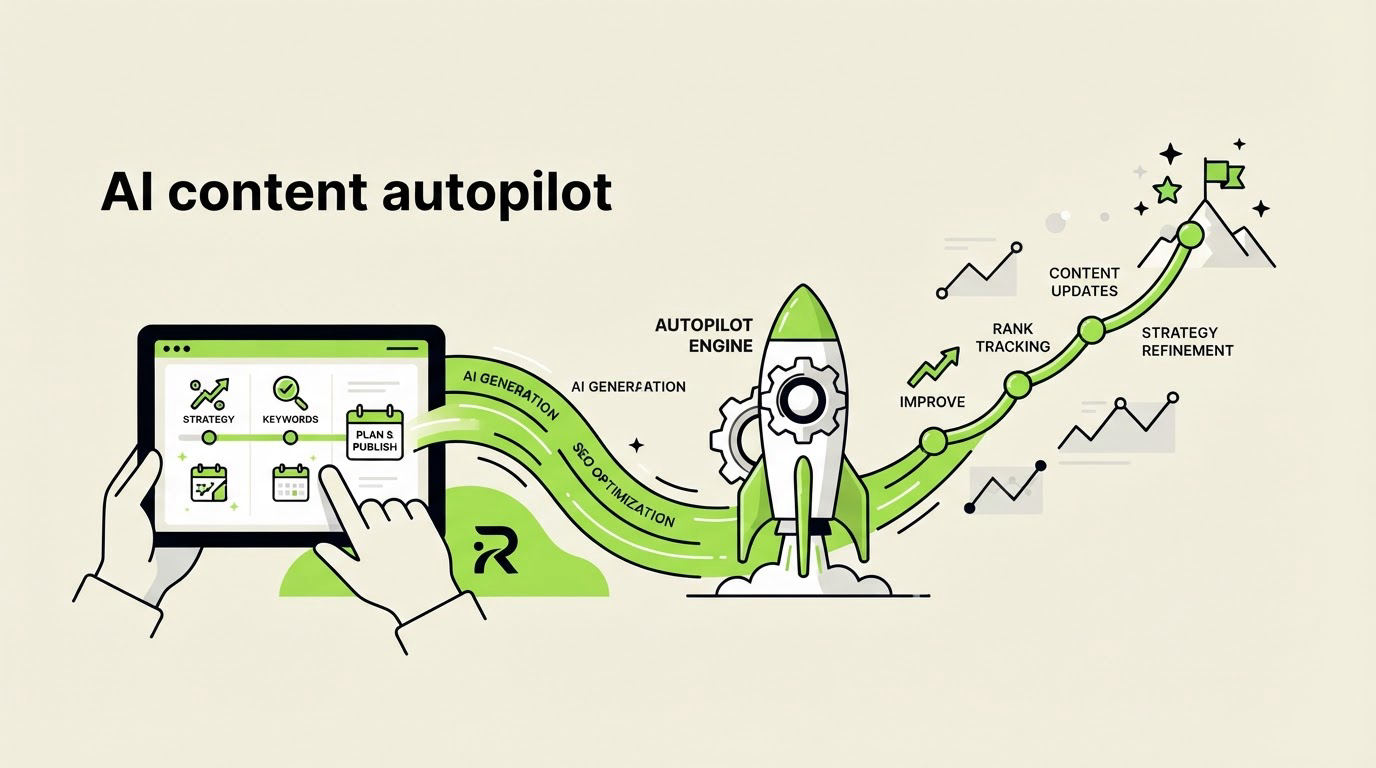
Teams can operate the workflow with separate research, drafting, and publishing tools. Rankdesk reduces the handoffs by organizing the work in the same sequence the content team needs.
Start with the site and target topics. Rankdesk researches your site, competitors, and keywords so the content plan starts with existing coverage and search opportunity. For the accounting firm, that research surfaces the tax-planning hub, duplicate blog angles, and supporting topics worth building next.
Next, create the article or landing page from the approved direction. Add business-specific details during review: the firm's advisory process, client eligibility, state-specific caveats, and appropriate service links. The Rankdesk features page explains the broader workflow available for content planning and production.
Then choose how much publishing control your team needs. A WordPress site can use the WordPress integration to move approved content into its publishing workflow. Teams with regulated advice, frequent pricing changes, or several stakeholders should keep a review gate. Teams producing stable educational content may use automatic publishing for approved templates and topic categories.
Finally, revisit performance. Expand pages that attract impressions but miss the reader's next question. Consolidate overlapping URLs. Refresh timely facts. Quality controls for automated publishing help retain editorial standards as output increases.
Improve Google rankings and AI assistant citations with WordPress content
WordPress works well for this approach because content teams can publish structured posts, maintain categories, edit internal links, and update pages as evidence changes. Results come from the content system around the platform: a defined topical focus, pages built for a visible search intent, and maintenance after publication.
For the accounting example, publish the freelancer quarterly-tax guide first because it supports an existing service page and addresses a recurring client problem. Follow with the S-corp compensation article, then add contextual links between the two only where readers benefit. Update both pieces before the next tax season, review title tags and descriptions, and use Search Console to see which questions bring impressions.
AI assistants draw from many sources and their answers can vary. Focus on citation-worthy materials: original explanations, clear author and organization information, verifiable sources, well-labeled pages, and details that answer the full question. Rankdesk's AI search optimization resources can help connect this work to a broader visibility plan.
Common AI content autopilot mistakes
The most damaging failure mode is publishing near-duplicate pages around slight keyword variations. northshoretax.example could easily create separate posts for "quarterly taxes for freelancers," "freelancer quarterly tax payments," and "freelancer estimated tax guide." One comprehensive guide with sections for each phrasing creates a cleaner experience and concentrates internal-link value.
Another issue is treating generated drafts as final research. Add expert review wherever mistakes could create financial, legal, safety, pricing, or product-fit problems. Keep a source list with the brief so reviewers can validate claims quickly.
A third issue is publishing at a pace the team cannot maintain. Begin with a manageable queue, such as one hub-supporting page per week, and make refresh work part of the calendar. A smaller set of maintained, connected pages creates more durable value than an abandoned archive.
FAQ about AI content autopilot
What is an AI content autopilot for SEO?
An AI content autopilot is a governed workflow that uses AI to research, plan, draft, review, publish, and improve SEO content. It combines automation with defined editorial decisions, source checks, internal linking, and performance monitoring.
Can AI content autopilot improve Google rankings?
It can improve the consistency and coverage of the work that supports rankings. Rankings depend on relevance, usefulness, crawlability, competition, site authority, and many other signals. Publish pages that solve the query thoroughly, maintain strong internal links, and use performance data to guide updates.
Should I publish AI-generated content automatically?
Automatic publishing fits stable page types with approved rules, trusted inputs, and clear quality checks. Keep human approval for sensitive topics, changing information, brand-critical pages, and content containing claims that require expert verification.
How can content earn citations from ChatGPT or Claude?
Create pages with direct answers, distinct expertise, clear entity information, supporting evidence, and durable URLs. Cover the topic fully, cite reliable sources, and keep the information current. Citations remain outside any publisher's control because each assistant chooses sources for each response.
Does Rankdesk work with WordPress?
Yes. Rankdesk supports WordPress publishing workflows through its WordPress integration. Use it to move approved, search-focused content toward publication while retaining the review process your team needs.
If you want a more consistent AI content autopilot for planning, drafting, and publishing search-focused pages, see how Rankdesk works. It researches your site, competitors, and keywords, then creates articles and landing pages you can review or publish automatically.