
AI Content Writer With Competitor Research: How to Build Stronger SEO Briefs
October 16, 2026

A search result can look crowded even when most ranking pages leave the reader with unanswered questions. Teams often respond by combining every competitor heading into a longer draft, which produces repetitive articles with little original value.
An AI content writer with competitor research helps when research becomes a clear editorial decision: identify the shared requirements of the result, locate omissions that fit your expertise, and build a brief around the reader's real task. Rankdesk supports that workflow by researching your site, competitors, and keywords before creating content for review or publication.
Quick answer: how to use competitor research to build an SEO brief
- Define one search query, audience, page type, and conversion goal.
- Review the first-ranking pages for intent, format, claims, sources, and page structure.
- Separate table-stakes coverage from meaningful gaps that your site can answer well.
- Turn the findings into a brief with a unique angle, outline, evidence plan, and internal links.
- Draft the article, add firsthand expertise and verification, then publish it to WordPress with deliberate on-page details.
- Measure impressions, rankings, clicks, and citation signals, then refresh the page from new search data.
Start competitor research with one clear page goal
Competitor analysis gets noisy when a topic has several intents. Search "WordPress SEO content" and you may find setup guides, plugin comparisons, editorial process advice, and agency service pages. Each page solves a different problem.
Write a one-sentence job for the page before opening competing results. For example: “Help a WordPress ecommerce manager create product education articles that answer buyer questions and support category-page conversions.” This sentence controls which pages are relevant, what evidence belongs in the article, and where a call to action can sit.
Use the same rule for AI-assistant visibility. Pages that earn citations tend to make specific claims easy to locate, attribute, and verify. A vague, all-purpose guide gives retrieval systems fewer clear passages to reuse. Google's guidance on creating helpful, reliable, people-first content provides a useful standard for the original experience and evidence readers expect.
Running example: a WordPress skincare store
Consider a WordPress store selling fragrance-free moisturizers. Its team wants to target “how to choose moisturizer for dry skin.” The product category page already exists at /moisturizers/dry-skin/, and the planned article should educate visitors before linking to that category.
The team initially gathers seven competing articles. Five offer a skin-type quiz, four explain humectants and occlusives, and six recommend products. Yet only two explain how climate, irritation, and routine order change the choice. None includes a simple decision path for someone using prescription acne treatments. That is a defensible gap if the store can source it carefully and have relevant advice reviewed.
Analyze competing pages before you create an outline
Export the ranking URLs into a worksheet and inspect the actual pages. Search snippets and SEO tool labels provide hints, while the page itself reveals how the answer works.
For each competitor, capture the primary intent, title promise, H2 topics, format, cited sources, author signals, publishing date, and conversion path. Also record the content that appears before the first major scroll. That section often shows what the page considers its essential answer.
| Research field | What to record | How it changes the brief |
|---|---|---|
| Search intent | Informational guide, comparison, product selection, or troubleshooting | Sets the article type and opening answer |
| Recurring topics | Concepts covered by at least several ranking pages | Forms the required core coverage |
| Evidence | Clinical sources, official guidance, original testing, or unsupported claims | Defines the sourcing and review requirements |
| Missing reader task | A decision, scenario, calculation, or next step absent from leading pages | Creates a useful original section |
| Site fit | Relevant category page, product expertise, expert reviewer, or existing guide | Determines whether your site can credibly publish it |
In the moisturizer example, “humectant versus occlusive” belongs in the core coverage because readers repeatedly encounter it across the result. A dry-climate routine and a prescription-treatment caution form the differentiating coverage. The article should avoid medical claims beyond its evidence. Link to appropriate primary guidance where needed and invite readers with persistent symptoms to seek professional care.
Google's Search Essentials are also useful during this review. They reinforce the value of accessible, crawlable pages and discourage tactics aimed at manipulating rankings rather than helping users.
Find meaningful content gaps in competitor research
A content gap earns space only when it meets three tests: readers need it, the current result serves it poorly, and your business can support the answer with real knowledge or reliable sources. A missing heading alone fails this test.
For the skincare article, a “best moisturizers for every skin condition” section would broaden the page far beyond its purpose. The stronger gap is narrower: a decision guide for choosing texture and ingredients based on dry-skin triggers, daily routine, and climate. It supports the query and leads naturally toward the store's category page.
Look for these signals while reading competitors:
- Repeated questions in comments, reviews, customer-support logs, and Search Console queries
- Explanations that list options without helping readers choose among them
- Claims with no source, date, limitation, or applicable scenario
- Generic recommendations that ignore audience constraints such as budget, location, platform, or experience level
- Missing connections to a practical next action
Keep the gap tied to a page purpose. Extra sections increase review time, create more chances for factual drift, and can make the article harder to scan.
Turn competitor findings into a focused SEO brief
A strong brief gives the writer decisions, source boundaries, and a clear order of operations. “Write a comprehensive article on dry skin moisturizer” leaves every important judgment unresolved.
For the running example, the brief could begin with a direct answer: choose a moisturizer based on the dryness trigger, texture preference, and the rest of the routine. It would then explain ingredient roles, provide a short decision flow, cover climate and treatment scenarios, and link to the dry-skin category after the reader has enough context to browse.
Specify these elements in the brief as prose or fields in your workflow:
- The primary query, search intent, target reader, and page conversion goal
- Required coverage from competing pages, with a reason for each section
- One to three differentiated sections supported by expertise or authoritative sources
- Exact internal pages to link and the context for each link
- Source requirements, claims requiring review, and statements to avoid
- A title direction, opening answer, section order, and desired call to action
For WordPress teams, map the brief to the publishing page before drafting. Choose the category, featured image requirement, author or reviewer information, schema approach, internal links, and product or category destination. Rankdesk's WordPress integration fits teams that want research-led articles to move into a familiar editorial and publishing workflow.
Use Rankdesk to move from research to a publishable article
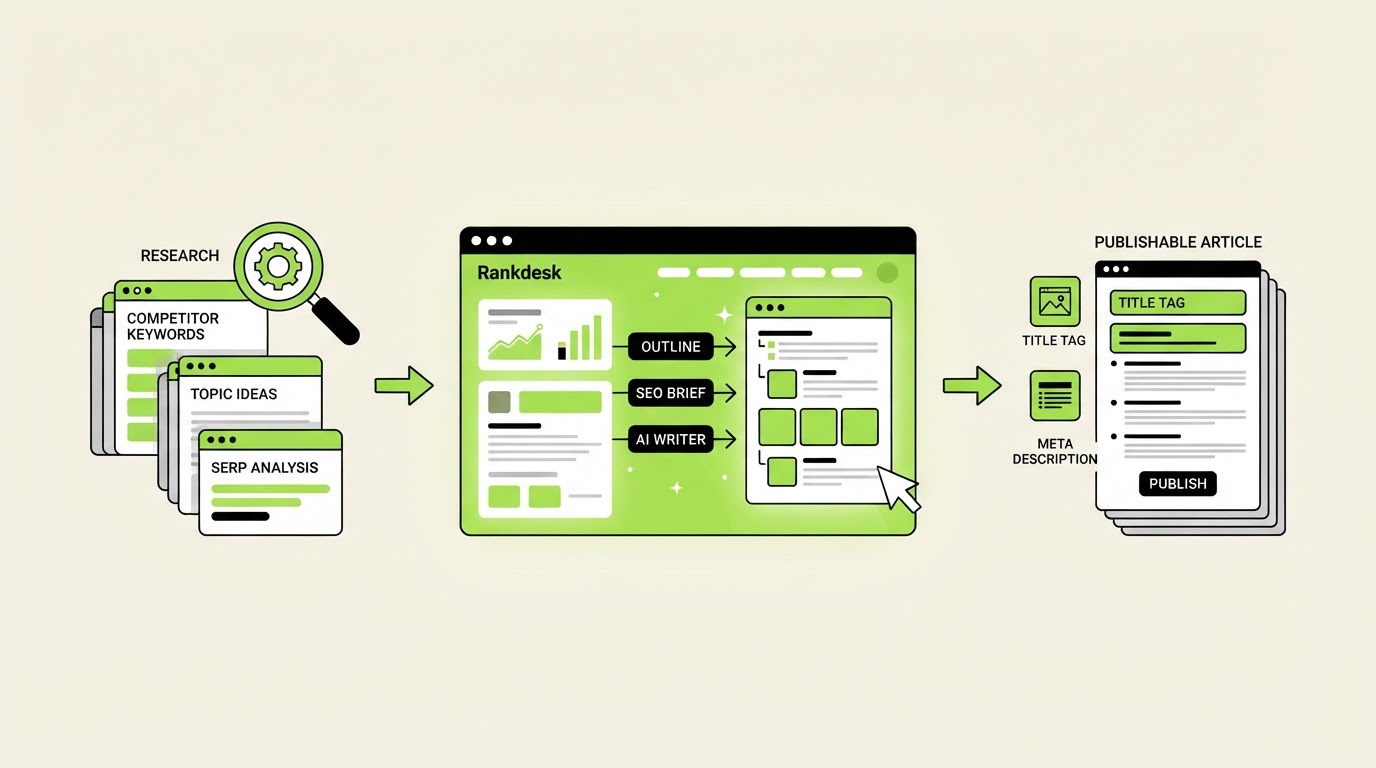
Manual research remains valuable, especially when the subject needs expert judgment. Rankdesk reduces the repetitive work of gathering site context, competitor patterns, and keyword direction into a content workflow.
Start with the domain and the article goal. Rankdesk can use the site, competing pages, and keyword context to shape the proposed article. Review the research output with the same questions used in the running example: which sections match the search intent, where does the draft have a credible gap to fill, and which statements require an external source or subject-matter review?
Next, guide the article toward the site architecture. For the skincare store, include the dry-skin category page and a related routine guide as intended internal links. Add the product constraints and editorial boundaries. The resulting article can then be reviewed for accuracy, voice, headings, claims, and the usefulness of its recommendations before publication.
This approach also helps prevent a common automation failure: publishing several pages built from the same competitor pattern. Build topic clusters with distinct reader jobs instead. This guide to automated SEO content, topic clusters, keyword maps, and internal links shows how planning links and page relationships improves that process.
Teams managing a larger calendar can also use the workflow described in How to Automate SEO Content Creation to assign review points from research through publication.
Publish WordPress articles that can earn rankings and AI citations
A well-researched article needs a page that search engines and readers can understand. In WordPress, give the post a descriptive URL, one visible H1, logical headings, descriptive image alt text, and internal links that lead to relevant next steps. Confirm that the published page is indexable and that its canonical URL matches the intended version.
For the moisturizer article, the opening paragraph answers the selection question quickly. The decision guide follows near the top. Ingredient explanations cite credible sources, and the product category link appears after the reader understands what to look for. The team also adds a reviewed author bio and a date for material updates.
Citation opportunities from AI assistants come from clear, useful passages with visible grounding. Use direct definitions, short decision criteria, specific conditions, and source-backed claims. Readers and retrieval systems benefit when the page identifies who the guidance is for and where its limits sit. For a deeper editorial approach, read How to Get Mentioned by ChatGPT.
Measure the results and refresh the brief
Publish the first version, then observe what the query data says. In Google Search Console, compare the page's impressions, clicks, average position, and the search terms that trigger it. The official Search Console performance report documentation explains the available metrics and filters.
If the moisturizer guide gains impressions for “moisturizer for dry skin in winter,” add a tightly focused subsection if the page has evidence for it. If visitors arrive for medical treatment questions, create a separate carefully reviewed page or clarify the article's scope. Preserve the central job of the original page.
Refreshes work best when they respond to a defined signal: a newly ranking competitor, a recurring query, outdated source material, product changes, or a section where readers leave without taking action. Keep a version note in the WordPress editorial record so the team can understand what changed and why.
Common mistakes with an AI content writer with competitor research
The most expensive mistake is treating top-ranking pages as a template to reproduce. This creates a familiar outline without giving the reader a reason to choose your page.
Another issue is asking the draft to cover every adjacent topic. The moisturizer example could quickly swell into acne treatment, eczema management, fragrance sensitivity, sunscreen, and makeup. Each topic deserves different evidence and a different reader promise.
Finally, do not skip editorial verification. Review every factual claim, recommendation, internal link, and product statement. AI speeds up synthesis and drafting; accountable publishing still requires a human owner.
FAQ
How many competitor pages should I analyze for an SEO brief?
Start with the first five to 10 relevant organic results, then expand when the result contains clearly different formats or intents. Depth beats a large unstructured list. Record patterns and gaps as you go.
Can competitor research help an article appear in AI assistant answers?
Yes, when it reveals unanswered reader questions and helps you create clear, source-backed passages. Citations remain outside any publisher's control. Focus on accurate expertise, direct answers, and an accessible page structure.
Should I publish AI-generated competitor research without editing it?
No. Validate the competitor findings, review sources, apply brand and legal requirements, and add information your team can stand behind. This review is especially important for health, financial, legal, and safety topics.
Can Rankdesk help agencies create briefs across several client sites?
Yes. Agencies can use a repeatable research-to-review workflow while preserving each client's audience, site structure, and editorial standards. See Rankdesk for agencies for the relevant workflow context.
If you want a more consistent way to turn competitor research into focused briefs and publish-ready articles, see how Rankdesk works. It researches your site, competitors, and keywords, then creates articles and landing pages you can review or publish automatically.