

AI Keyword Research and Content Writer for SEO Publishing
A promising keyword can still produce a weak page when the brief misses the reader's decision, the draft lacks proof, or publishing slows down. Teams often end up with spreadsheets full of ideas and a blog with long gaps between useful posts.
An AI keyword research and content writer brings research, drafting, review, and publishing into one operating process. Rankdesk is built for that process, including WordPress publishing and content designed for traditional search results and AI-assisted discovery.
Quick answer: how to use AI keyword research and content writing
Use this workflow to turn a search opportunity into a publishable page:
- Choose a commercial topic with a clear reader problem, offer, and destination page.
- Research the search results, related questions, competing pages, and gaps on your own site.
- Create a brief with search intent, a working title, required evidence, internal links, and a conversion action.
- Generate a structured draft, then verify claims, examples, product details, and source links.
- Publish to WordPress as a draft or approved post, then monitor impressions, clicks, and query movement.
How to research keywords before you write
Start with a page type and audience, then work outward. A regional accounting firm, for example, may want qualified leads for tax planning rather than broad traffic around accounting definitions. Its starting topic could be “tax planning for small business owners.”
Export the last 90 days of Search Console data first. Look for queries that already earn impressions, especially terms where the site ranks on page two or three. Google's Performance report documentation explains how Search Console groups search data and query metrics.
For the accounting firm, the review reveals impressions for “small business tax planning checklist,” “quarterly estimated tax planning,” and “tax strategies for LLC owners.” The team chooses a guide at /tax-planning-small-business/ because it supports the firm's advisory service and gives readers a practical next step.
A useful keyword decision uses four signals:
- The query has a clear problem the business can help solve.
- The search result format fits a page the site can credibly publish.
- The subject connects to an existing service, category, or conversion path.
- The site can add firsthand expertise, current sources, or a better decision framework.
Keyword volume alone leaves too much to chance. Prioritize fit, page intent, and evidence. For a deeper process that uses competing pages as research input, see this guide to an AI content writer with competitor research.
How an AI keyword research and content writer builds a brief
The brief gives the draft boundaries. It also prevents a common failure: publishing a broad article that covers several intents shallowly and satisfies none of them.
For the tax-planning example, the brief calls for a practical annual calendar, a section for LLC owners, a checklist of documents to bring to an advisor, and a call to book a planning meeting. It excludes individualized tax advice and assigns a subject-matter reviewer to validate dates, thresholds, and terminology before publication.
Use the following brief fields every time:
| Brief field | Decision for the tax-planning example | Result in the published page |
|---|---|---|
| Primary intent | Business owners seeking proactive planning help | Service-led educational guide |
| Primary URL | /tax-planning-small-business/ | One canonical destination for internal links |
| Evidence required | IRS source links and advisor review | Claims readers can verify |
| Conversion action | Request a tax-planning consultation | Clear next step after the checklist |
| Supporting topics | Estimated taxes, entity type, recordkeeping | Sections that answer follow-up questions |
Give the writer source material that reflects your actual offer. Include service pages, product documentation, approved case details, editorial standards, and terms your team uses with customers. This creates a page with a recognizable point of view instead of generic prose.
Google's guidance on helpful, reliable, people-first content emphasizes original information, clear expertise, and a useful purpose. Build those requirements into the brief before generating a single paragraph.
How to write and review SEO content with AI
Generate the first draft from the approved brief, then edit it as a publisher. A review pass should check factual accuracy, search intent, links, and conversion relevance before anyone schedules publication.
In the accounting example, the first draft included a sentence that implied every LLC owner should elect S corporation status. The reviewer replaced it with a short explanation of eligibility and a prompt to discuss entity choice with a qualified professional. That edit protects readers and makes the page more credible.
Review the draft in this order. Check the title and opening first, because they establish the promise to the searcher. Then confirm each section answers a real follow-up question, validate every time-sensitive claim, and add internal links that help a reader continue their task. Finish by reviewing the call to action against the page's commercial purpose.
For an editorial process that assigns clear responsibilities from draft to approval, use the step-by-step workflow for SEO articles. Before publication, run the same page through a pre-publishing quality checklist to catch unsupported claims, thin sections, and broken destinations.
How to publish AI-assisted articles to WordPress
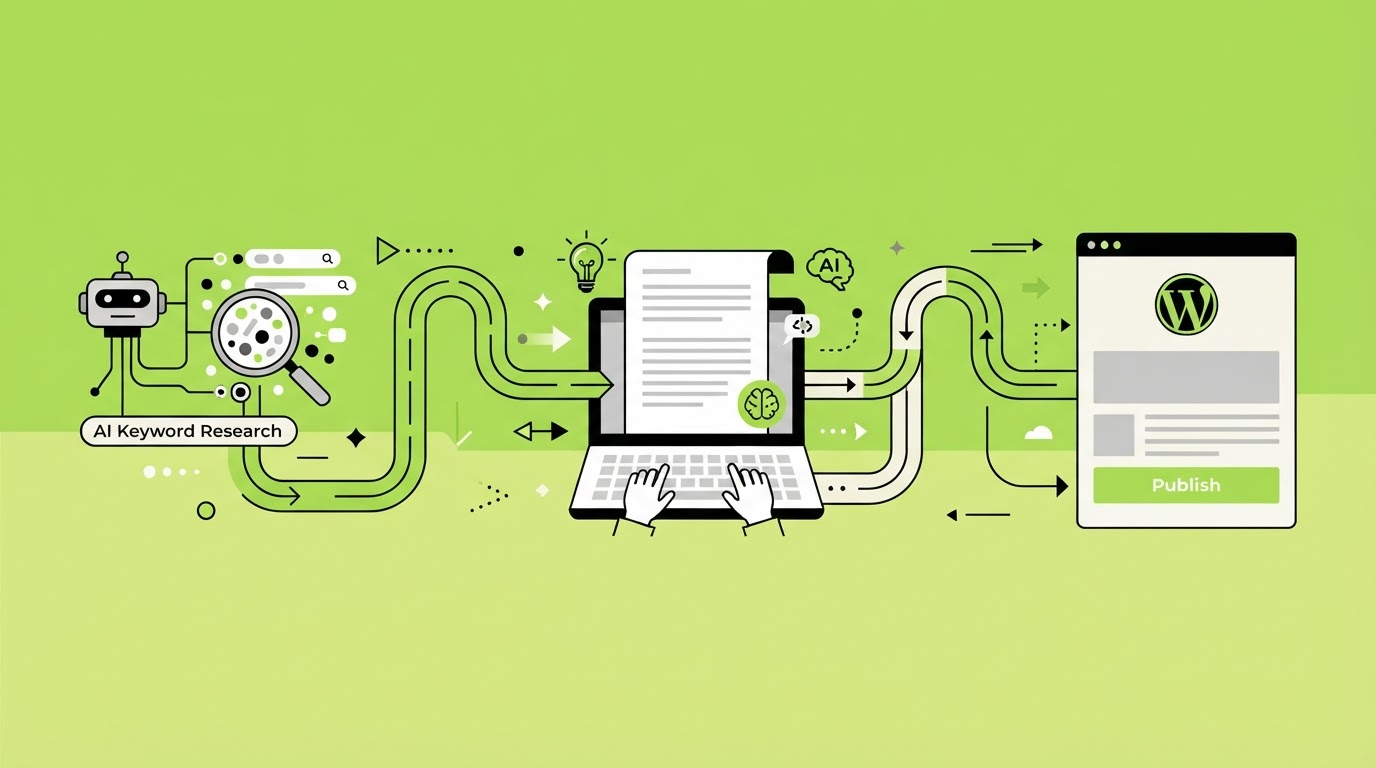
WordPress works well when the publishing process preserves editor control. Connect the site, select the destination, map the title and body fields, and decide whether each approved article should arrive as a draft or go live automatically.
For the tax-planning guide, publish first as a WordPress draft. The editor can inspect the slug, featured image, author byline, internal links, category, and excerpt inside the CMS. Once the tax reviewer approves the page, schedule it before the next quarterly estimated-tax deadline.
Rankdesk supports this practical route through its WordPress integration. Teams that publish to a custom stack can also plan around an AI content publishing API when WordPress is not their destination.
After the post is live, add internal links from relevant service and resource pages to /tax-planning-small-business/. Return to Search Console after enough data has accumulated, then compare the queries that triggered impressions with the questions answered on the page. Expand weak sections where the data reveals an unmet need.
Use Rankdesk for keyword research, writing, and WordPress publishing
A manual workflow can work for a small editorial calendar, though research files, briefs, drafts, and CMS handoffs quickly become difficult to track. Rankdesk reduces that administrative load by organizing the workflow in one place.
Begin by adding the site and defining the topic area. Rankdesk researches your site, relevant competitors, and keyword opportunities so the team can select an opportunity tied to a real business page.
Next, create the article or landing-page assignment from the chosen topic. The workflow produces a search-focused draft with a logical structure, while your team supplies the facts, examples, positioning, and approval standards that make the page useful.
Then review the output before publication. Editors can refine the title, opening, links, calls to action, and claims. The tax-planning page remains a draft until the firm's reviewer confirms every technical statement.
Finally, send the approved piece to WordPress through the connected publishing flow. Explore the full Rankdesk feature set and see the broader process on the How It Works page. This approach gives content teams a repeatable path from opportunity to publishable page.
How AI keyword research supports citations from AI assistants
AI assistants tend to surface sources that answer a question directly, identify the entity behind the information, and provide support for important claims. Strong pages also help traditional search users who need a clear, trustworthy answer.
For the accounting guide, that means stating who the firm serves, explaining what tax planning covers, linking to official sources where applicable, and using headings such as “When should a small business start tax planning?” The page needs a clear publication date, reviewer details where relevant, and content that reflects the firm's actual service process.
Build entity consistency across your site. Keep the business name, services, locations, and contact details aligned on core pages. Publish focused supporting resources that answer adjacent questions, then link them together with descriptive anchors. Rankdesk's AI search optimization approach covers the content and entity work that supports visibility across search experiences.
Common mistakes with AI keyword research and writing
The largest risk comes from treating generation as the whole job. Search performance depends on the research decision, the evidence in the page, the publishing quality, and the work done after launch.
Avoid selecting a topic purely because it looks large. A broad “small business taxes” page may attract diverse visitors while producing few advisory inquiries. The more specific tax-planning page gives the firm a clearer reason to earn the click and a clearer action for the reader.
Avoid publishing unreviewed factual claims. Industries with legal, financial, medical, or technical requirements need qualified review. Keep a review record for sensitive pages and refresh time-sensitive material on a schedule.
Avoid producing near-duplicate location or service pages at scale. Every page needs a distinct purpose, source material, and useful local or product-specific information. For more guidance on building scalable pages responsibly, read the guide to programmatic SEO landing pages.
FAQ
Can AI keyword research find topics my site can rank for?
It can identify opportunities from your existing pages, competing results, and search patterns. Final selection should account for your site's authority, the quality of available evidence, and the value of the conversion path.
Should I publish AI-generated SEO articles directly to WordPress?
Direct publishing suits content that follows a proven template and has established approval rules. Use drafts for pages with regulated information, new service claims, important commercial pages, or time-sensitive facts.
How often should I update keyword research?
Review Search Console data monthly for active content programs. Revisit priority pages after major product changes, seasonal shifts, ranking changes, or new questions from sales and customer support.
Can this workflow help content appear in AI assistant answers?
It improves the quality signals that make a source easier to assess: direct answers, accurate claims, clear entity information, supporting sources, and internally connected topical coverage. Citation decisions remain with each AI assistant and its retrieval systems.
If you want a more consistent way to research keywords, write useful pages, and publish to WordPress, see how Rankdesk works. It researches your site, competitors, and keywords, then creates articles and landing pages your team can review or publish automatically.
Start auto-writing for your site today
Create a free account, connect your site and generate your first article in minutes. No credit card needed.