
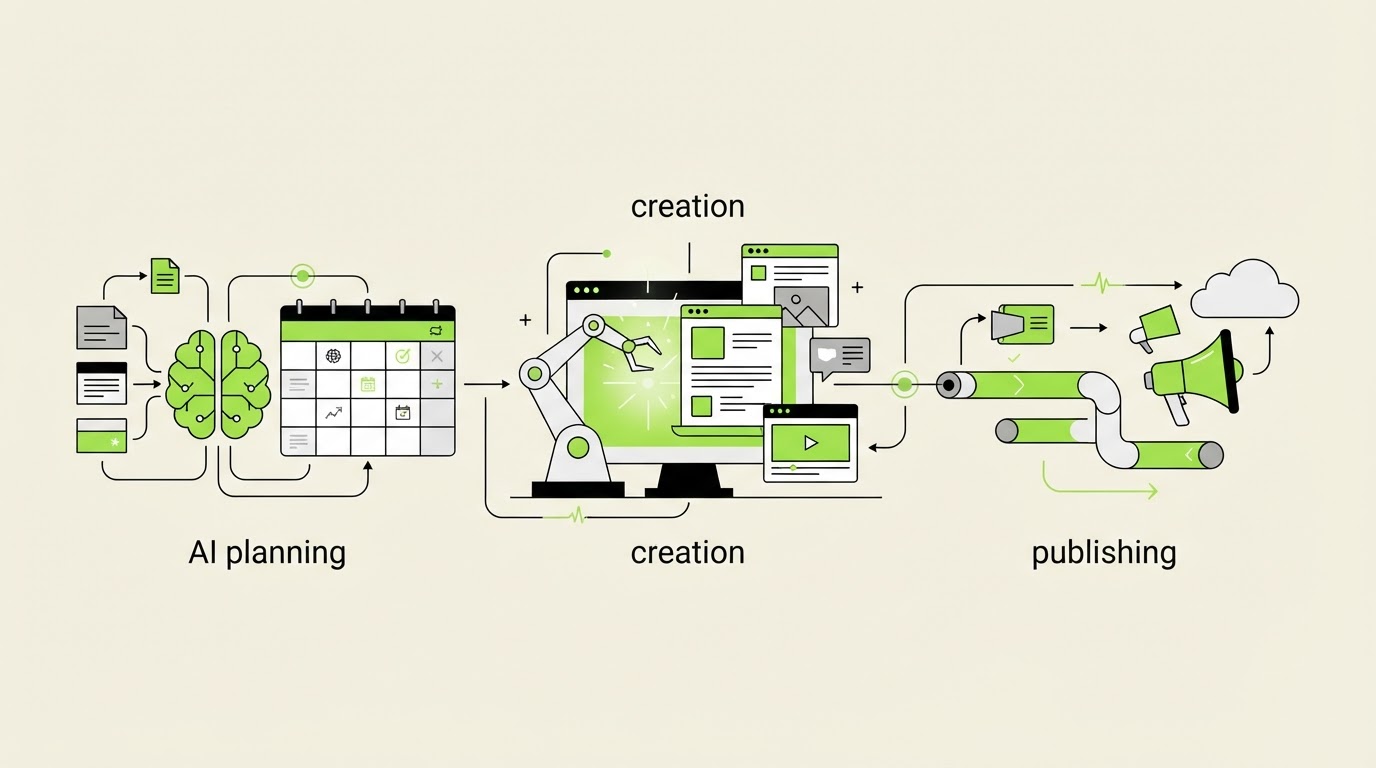
AI Content Workflow Automation: Plan, Create, and Publish
A content calendar often breaks down between the keyword list and the CMS. Research sits in spreadsheets, drafts lose their intended search angle, editors spend time fixing repeated issues, and published pages lack the internal links that help readers continue.
AI content workflow automation connects those stages into one controlled process. Rankdesk helps teams research opportunities, create search-focused drafts, review them against site context, and publish to supported CMS platforms such as WordPress.
AI content workflow automation: the quick answer
Use this workflow to move from a content opportunity to a measurable published page:
- Map keywords to a specific page type, audience, and search intent.
- Inspect your existing URLs and competing results before assigning a new topic.
- Create a brief with the page angle, evidence requirements, internal links, and conversion goal.
- Generate a draft from the brief, then check factual claims, positioning, and overlap with existing pages.
- Add descriptive headings, source links, internal links, metadata, and a clear next step.
- Publish through your CMS, validate the live URL, and measure impressions, clicks, rankings, and assisted conversions.
- Refresh pages using performance data, then expand topics that show qualified demand.
How to plan an AI content workflow before drafting
Start with a page inventory. Export the last 90 days of Google Search Console data and group URLs by purpose: product pages, comparison pages, educational articles, use-case pages, and support content. The Search Console Performance report documentation explains the query, page, country, and device data available for this review.
Then assign one primary intent to each planned URL. A person searching for a workflow needs a practical operating model. A person comparing platforms needs decision criteria. Combining both goals in one page tends to create vague copy and weak conversion paths.
Consider a fictional company called Cedar Ledger, which sells close-management software for mid-market finance teams. Its team finds growing impressions for “month-end close checklist” on /blog/month-end-close-checklist, while its existing product page already targets close-management software. The editorial decision is to improve the checklist article with a downloadable operating template and internal links to the product page. Creating another software-focused article would split relevance across two URLs.
A useful planning record contains the target URL, primary query theme, reader stage, unique evidence, linked product or service page, reviewer, and publication status. This gives automation a clear job. For a deeper planning model, see this guide to keyword maps and internal linking for topic clusters.
How to create AI content that has a clear search purpose
A strong brief supplies the information a capable editor would ask for before writing. Include the reader's task, the decision they need to make, the page's promised outcome, required examples, source standards, related URLs, and prohibited claims.
For Cedar Ledger, the brief calls for an 11-step checklist organized around close preparation, transaction reconciliation, approvals, variance review, and post-close reporting. It also requires a section for teams with multiple entities. That detail separates the page from generic checklist content and gives finance leaders a reason to use it.
Use AI to assemble a first draft from this context, then review the substance before polishing sentences. Check every product fact against approved material. Replace broad claims with operational detail. Add examples that reflect the reader's actual work.
Google recommends content that provides original information, substantial value, and clear evidence of expertise in its guidance on helpful content. Build those requirements into the brief and review stage instead of treating them as a final editing task.
The most common failure occurs when a new draft overlaps an existing URL. Cedar Ledger's first outline includes a section on “accounts payable automation,” yet the site already has a detailed guide on that topic. The editor changes the section into a short contextual link and keeps the checklist focused on month-end close. This protects topical clarity and gives readers a useful path forward.
AI content workflow automation quality controls before publishing
Automation benefits from explicit gates. A draft should pass through research, editorial, legal or subject-matter review where required, and CMS validation. The right gates depend on your industry and publishing volume, yet every workflow needs an accountable owner for final publication.
| Workflow stage | Required check | Cedar Ledger decision | Result |
|---|---|---|---|
| Keyword mapping | One intent per URL | Keep “month-end close checklist” on the existing checklist URL | Prevents topic overlap |
| Research | Verify claims and examples | Cite accounting standards guidance where relevant | Improves trust |
| Draft review | Add site-specific expertise | Include multi-entity close steps | Creates a differentiated page |
| On-page SEO | Confirm title, headings, links, and metadata | Link to close-management product page | Supports discovery and conversion |
| CMS review | Check slug, formatting, canonical, and indexability | Publish to /blog/month-end-close-checklist | Avoids technical errors |
| Measurement | Review search and business signals | Track query growth and template downloads | Prioritizes the next refresh |
Editorial controls also support visibility in AI-generated answers. AI assistants tend to favor pages with direct explanations, well-labeled sections, credible sources, and accessible supporting context. Citations from AI assistants remain outside any publisher's control, so focus on publishing information that is easy to verify and genuinely useful. Rankdesk's AI search optimization guidance explains how content structure and source quality support that goal.
How Rankdesk automates the workflow from research to WordPress

Rankdesk turns the process above into a repeatable production flow while keeping your team in charge of the editorial decision.
First, connect the site and define the topics or services that matter. Rankdesk can use your domain, competitors, and keyword opportunities to shape content opportunities around the pages your site needs.
Next, select the opportunity and create the page with its intended audience and search goal. The draft can incorporate a structured outline, on-page SEO elements, and suggested internal linking opportunities. Editors can then apply brand knowledge, add first-hand examples, verify claims, and approve the final copy.
Then publish to WordPress through the Rankdesk WordPress integration. Cedar Ledger's editor sends the approved checklist to WordPress, checks the title tag and preview, confirms the correct category and featured image, and publishes the existing URL update. This avoids copying formatted content between separate tools.
Finally, return to performance data on a schedule. If the checklist gains impressions for “month-end close process,” the team can add a focused section that answers that task directly. If readers reach the template call to action but rarely submit, the team can revise the offer and surrounding copy.
Explore the full sequence on the How Rankdesk works page. Teams evaluating research quality can also use the practical guidance in how to use AI with competitor research.
When to automate publishing and when to require review
Direct publishing works well for repeatable content with stable inputs, such as location pages based on approved templates, product category introductions, or scheduled updates to established article formats. Set content rules before activating automated publishing: approved sources, required links, author or reviewer ownership, and a process for exceptions.
Require review for regulated topics, pricing, product claims, strategic comparison pages, and subjects where experience carries much of the value. A review queue also helps when a site is still establishing its tone and topical boundaries.
For Cedar Ledger, evergreen glossary entries can move through a lighter review path. The month-end checklist stays in the full editorial queue because it influences product evaluation and includes advice that finance leaders may apply to real processes. This approach preserves speed without weakening governance. Read more about editorial safeguards in the pre-publishing quality checklist.
How to measure AI content workflow automation results
Track production health and search outcomes together. Production metrics reveal bottlenecks: time from brief to approval, revision cycles, publication consistency, and the share of drafts that require major rework. Search metrics reveal whether the published work matches demand: impressions, clicks, query coverage, indexed pages, engagement, leads, and assisted conversions.
Review results by topic cluster rather than judging a page in isolation. Cedar Ledger may find that the checklist attracts early-stage visitors while the linked product page drives demo requests. Both pages contribute to the workflow's commercial value.
Set a monthly review. Keep pages that build qualified traffic, improve pages with meaningful impressions and weak clicks, and consolidate content that competes for the same audience. The workflow gets stronger because every cycle produces cleaner planning data.
FAQ about AI content workflow automation
Can AI content workflow automation publish directly to WordPress?
Yes. Rankdesk supports WordPress publishing, allowing approved content to move from the workspace into your CMS. Review the live preview, URL, metadata, category, internal links, and indexability before release.
Can automated content improve Google rankings?
Automation improves consistency and reduces manual production work. Ranking growth depends on intent match, useful original information, technical accessibility, internal linking, authority, and the competitive strength of the results page.
How do pages earn citations from AI assistants?
Create accurate pages that answer a defined question directly, support claims with credible sources, use descriptive headings, and build clear topical connections across the site. Monitor referral traffic and branded search trends, while recognizing that assistant citation behavior changes over time.
What content should stay in a human review queue?
Keep regulated advice, legal or financial claims, pricing, product specifications, comparison content, and high-stakes conversion pages in a review queue. Subject-matter input adds the specificity that generic drafts lack.
If you need a consistent way to plan, create, review, and publish search-focused content, see how Rankdesk works. It researches your site, competitors, and keywords, then creates articles and landing pages your team can review or publish automatically.
Start auto-writing for your site today
Create a free account, connect your site and generate your first article in minutes. No credit card needed.