

AI Blog Generator for Search-Focused Publishing
A weak draft can create more editorial work than a blank page. It often targets the wrong query, repeats generic advice, and reaches publication without the product details, links, or source checks a real reader needs.
An AI blog generator earns its place when it supports a complete search workflow: research, briefing, drafting, review, publishing, and measurement. Rankdesk is built around that workflow, helping teams turn site, competitor, and keyword research into articles and landing pages ready for review or automated publication.
Quick answer: how to use an AI blog generator
Use this workflow to produce articles that have a clear search purpose and a credible path to publication:
- Choose one query, one audience, and one action the reader should take.
- Research the existing site, search results, competitors, and gaps in the current coverage.
- Build a brief with the search intent, angle, source requirements, internal links, and page structure.
- Generate a complete draft around the brief, then add business-specific expertise and verified facts.
- Review the article for accuracy, topical overlap, conversion paths, and technical publishing details.
- Publish to WordPress, monitor impressions and clicks, then refresh pages that show demand.
How an AI blog generator should start with search intent
Start with the page's job. A how-to query needs ordered instructions. A comparison query needs decision criteria. A commercial query needs enough practical detail for a buyer to evaluate the next step.
For example, consider an illustrative local service site called Northwind Pest Control. Its existing page at /mosquito-control/ describes treatment plans. The team wants a supporting article that can attract homeowners earlier in the decision process.
The first proposed topic was “mosquito treatment cost and DIY prevention.” That brief joined two separate intents: people seeking a price estimate and people seeking yard-prep instructions. Split the work before generating anything:
- Create
/blog/mosquito-control-cost-guide/for pricing factors and service evaluation. - Create
/blog/prepare-yard-for-mosquito-treatment/for a practical preparation checklist. - Link each article to
/mosquito-control/with descriptive, reader-focused anchor text.
This decision prevents a broad draft from trying to satisfy incompatible readers. It also gives every page a cleaner internal-link role.
Google's Search Essentials provide a useful baseline: make pages accessible to crawlers, create people-first material, and avoid tactics designed mainly to manipulate rankings. Apply those principles before opening the generator.
Build the brief before generating the article
A strong brief gives the model boundaries. Write the intended reader, query, page type, required proof, unique angle, and next-page link. Then collect inputs from the actual business: service area, process, product constraints, policy details, and subject-matter review notes.
For Northwind's yard-preparation article, the brief calls for a homeowner who has booked a treatment, a 700 to 1,000 word guide, and an answer that appears in the opening section. It also requires a note that pet bowls and children's outdoor items should be moved according to the technician's instructions. That line needs verification from the business, since treatment protocols vary.
Use current search results to identify the questions readers expect answered. Use competitor pages to find coverage gaps, then write an angle that reflects the site's own experience. Our guide to using competitor research in an editorial workflow shows how to use rival coverage as research input while keeping the final article original.
Google's helpful content guidance also supports this approach. First-hand experience, clear purpose, and sufficient detail create a better page than a lightly edited generic draft.
Generate a draft with a clear editorial job
Ask for useful sections, concrete decisions, and source-aware claims. The draft should answer the primary question early, expand it in a logical order, and send qualified readers to the relevant service or product page.
Northwind's draft can include these sections: what to move before treatment, how to manage standing water, what to tell the technician, and when to return pets to the yard. The cost discussion belongs on the separate pricing page. Keep that boundary during revision.
Use the generator to accelerate structure and first-draft production. Keep people responsible for the parts that require organizational knowledge: safety language, product specifications, legal claims, customer commitments, and local details.
| Workflow option | Research context | Editorial control | Publishing route | Best fit |
|---|---|---|---|---|
| Manual drafting | Gathered separately by the team | Full, with slower production | Copy and paste | High-stakes pages with limited volume |
| Prompt-only generator | Depends on the prompt supplied | Requires a separate review process | Usually manual export | Early ideation and one-off drafts |
| Rankdesk workflow | Site, competitor, and keyword research inform the work | Brief, draft, and review decisions stay visible | Review first or automate publication | Recurring search-focused content programs |
Avoid publishing a first draft unchanged. Check every claim that could affect a customer's decision. Replace broad statements with specific examples from the business. Add internal links where they help the reader continue their task.
For a repeatable review process, use this pre-publishing quality checklist. It covers factual review, duplicate-topic risk, page structure, internal linking, and on-page readiness.
Use Rankdesk as your AI blog generator for WordPress
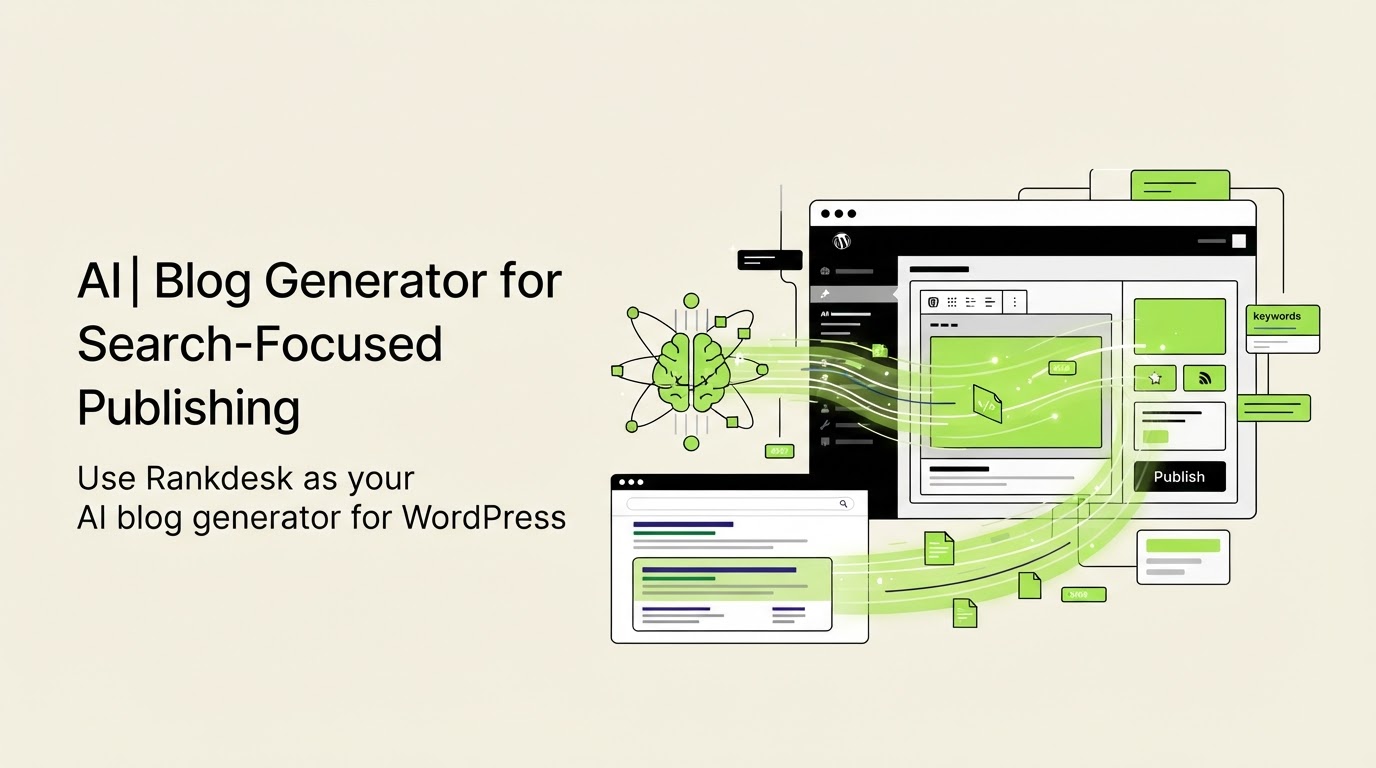
Rankdesk removes the handoffs that usually separate research, drafting, and publishing. The workflow begins by adding the site and defining the topic area. Rankdesk uses site, competitor, and keyword research to shape article and landing-page opportunities.
Next, choose the topic and review the planned direction before the draft is created. For the Northwind example, select the yard-preparation intent, keep the treatment-cost query in its own plan, and set the mosquito-control service page as the primary conversion destination.
Then generate the article and edit it in context. Add the technician-approved preparation instructions, check the suggested page structure, and confirm that the service-page link fits naturally. Teams can use the broader Rankdesk workflow to move from planning through review with fewer disconnected tools.
For WordPress sites, connect the publishing destination through the WordPress integration. Select review before publishing when service details, regulated claims, or new product language require a human sign-off. Use automated publication for established formats with stable rules and an active quality process.
WordPress supports content workflows through its REST API documentation, which explains the platform's structured approach to working with posts and other site resources. Keep WordPress categories, tags, author settings, featured images, and canonical rules aligned with the site's publishing standards.
Publish articles that can support Google rankings and AI citations
A page earns search visibility by giving a complete, credible answer to a real query. The same qualities help AI assistants identify material worth referencing: clear entity information, direct answers, cited facts where appropriate, and page-level expertise.
For Northwind, the author byline should identify the qualified reviewer, the service page should clarify the company and coverage area, and the preparation guide should give direct instructions that a homeowner can use. Add a short FAQ only when the questions are genuinely common. Keep the advice consistent across service pages, business profiles, and supporting articles.
Rankdesk supports a content system where every article can strengthen a broader topic cluster. Read how to improve the chances of being mentioned by ChatGPT for a focused guide to entity clarity, citations, and content structure for AI search.
Common AI blog generator mistakes
The most expensive mistake is publishing volume without a topic map. That approach creates near-duplicate articles, scattered internal links, and thin coverage of the pages that actually support sales.
Another frequent issue is a vague prompt with no business inputs. A generator can produce fluent copy from limited context, yet fluent copy alone rarely contains the operational details that make a page trustworthy.
Treat performance review as part of the publishing cycle. Export the last 90 days of Search Console data first. Find pages with impressions and weak click-through rates, then improve the title, opening answer, and match between query and page intent. For pages with clicks but weak conversions, inspect the page's offer, internal links, and next action.
FAQ about AI blog generators
Can an AI blog generator publish directly to WordPress?
Yes, a connected workflow can send approved articles to WordPress. Set publishing rules first, including category assignment, image requirements, author review, URL conventions, and whether new posts require approval. Start with reviewed publication until the team has validated the output across several posts.
Will AI-generated blog posts rank on Google?
Google evaluates pages against quality and usefulness signals. Ranking depends on relevance to the query, crawlability, content quality, links, site authority, and the competitive results already present. Give each article a specific purpose, verified information, and useful internal paths.
How many articles should I generate each month?
Publish at the pace your team can research, review, and measure properly. A focused plan of four well-supported articles can create more durable value than a large batch of overlapping drafts. Match volume to subject-matter capacity and the number of meaningful keyword opportunities.
How do I prevent duplicate topics across AI-generated articles?
Maintain a content map with one primary query and one dominant intent per URL. Review existing pages before approving a new brief. When two ideas serve the same search need, refresh the stronger URL or merge the material into one comprehensive page.
If you want a more consistent way to plan, write, and publish search-focused blog content, see how Rankdesk works. It researches your site, competitors, and keywords, then creates articles and landing pages you can review or publish automatically.
Start auto-writing for your site today
Create a free account, connect your site and generate your first article in minutes. No credit card needed.