
How to Use a Shopify AI Blog Writer for Product Guides That Rank
October 14, 2026
A Shopify store can have excellent products, detailed support tickets, and knowledgeable staff while its blog publishes broad articles that never help a shopper choose. The result is weak organic traffic and few pages worth citing in AI assistant answers.
A Shopify AI blog writer becomes useful when it turns firsthand product knowledge into clear, evidence-led buying guides. Rankdesk supports that workflow by helping ecommerce teams research opportunities, create a structured draft, publish to Shopify, and track search visibility.
Quick answer: how to use a Shopify AI blog writer
Use this workflow to turn product expertise into Shopify guides:
- Collect product specifications, customer questions, reviews, policies, and expert advice for one buying decision.
- Choose a search topic with clear commercial relevance and map the guide to relevant collection and product pages.
- Build a detailed brief with selection criteria, comparison points, first-party evidence, and a useful answer structure.
- Draft the guide, then verify every product claim, recommendation, availability detail, and internal link.
- Publish the finished article in Shopify with a descriptive URL, title, meta description, images, and links to products.
- Track impressions, clicks, rankings, referral behavior, and AI assistant mentions. Refresh the guide when product facts or search demand change.
Start your Shopify AI blog writer workflow with customer evidence
The strongest buying guides answer questions customers already ask before purchasing. Export the last 90 days of support conversations, product reviews, returns reasons, onsite search terms, and sales-team notes. Group the findings by decision point.
For example, imagine a Shopify store that sells home espresso equipment. Its best-selling grinder category receives recurring questions such as:
- Which burr type suits espresso?
- Can this grinder fit under a cabinet?
- How loud is it during an early-morning routine?
- Which model works with a pressurized basket?
- What should a first-time buyer budget for accessories?
These questions provide the raw material for a guide such as /blogs/coffee-guides/how-to-choose-an-espresso-grinder. The guide can help people compare options before they reach a product page.
Gather facts from the people who can validate them. Ask the merchandising lead for dimensions and compatibility details. Ask customer support which setup errors lead to returns. Ask the product specialist to explain burr geometry in plain language. Keep source links or internal documentation beside every claim during drafting.
This source file protects the editorial process from generic advice. It also gives the page details that search engines and AI systems can associate with real product expertise. For a broader ecommerce workflow, see AI Blog Writer for Ecommerce: Turn Product Expertise Into Search Traffic.
Choose Shopify buying guide topics that can lead to products
A useful guide sits between an informational question and a purchase decision. The reader needs enough detail to choose, plus an obvious route to a relevant category or product.
For the espresso store, “best espresso grinder” may be too broad for an early guide. “How to choose an espresso grinder for a small kitchen” offers a more specific reader, practical selection criteria, and relevant product links. It also creates room for original details such as cabinet clearance, sound levels, hopper capacity, cleaning effort, and workflow speed.
Review the search results before committing. Look for missing explanations, outdated specs, copied comparison tables, or a lack of advice for a clear use case. Then choose an angle your store can support with real knowledge.
Map the article before writing. The grinder guide should link to the grinder collection, individual models that meet stated criteria, a dosing funnel accessory, and a maintenance guide. Product links should appear after the reader has enough context to understand why each option fits.
Shopify lets merchants create and manage posts from the admin blog area, including titles, excerpts, tags, search listing details, and publication controls. Use Shopify’s official blog management guidance to confirm the current fields available in your store.
Build a source-worthy product guide brief
A source-worthy guide makes a clear claim, shows the criteria behind it, and gives readers enough detail to check the recommendation. AI assistants and search users both benefit from pages with explicit answers, accurate entities, and scannable supporting evidence.
Create a brief with a one-sentence reader outcome. For the grinder example: “Help apartment-dwelling espresso beginners choose a grinder that fits their space, coffee routine, and machine.” That outcome keeps the article from becoming a catalog of loosely related products.
Include these elements in the brief:
- The reader’s machine type, experience level, space limits, and budget range
- Selection criteria with definitions, such as burr type, adjustment range, retention, noise, and footprint
- Verified product specifications and compatibility notes
- Questions that deserve direct answers near the top of the guide
- Product and collection pages that serve as the next step
- A refresh trigger, such as a discontinued model or revised product specification
The espresso guide could open with three shopper profiles: a beginner with a compact semi-automatic machine, a household making several milk drinks daily, and an experienced user refining espresso recipes. Each profile can point toward meaningful features rather than declaring a universal winner.
Here is a practical editorial standard for the article.
| Guide element | What to include | Why it helps the shopper | Shopify destination |
|---|---|---|---|
| Direct recommendation | Best fit by use case, with conditions | Gives a fast starting point | Relevant collection page |
| Decision criteria | Burrs, adjustment, size, noise, retention | Explains how to compare models | Supporting educational post |
| First-party product facts | Measurements, included parts, care needs | Supports confident evaluation | Product page |
| Trade-offs | Counter space, workflow speed, cleaning effort | Sets accurate expectations | Alternative product or collection |
| Maintenance advice | Cleaning frequency and replacement parts | Reduces post-purchase friction | Accessories and care products |
Avoid unsupported superlatives. A statement such as “quiet enough for a small apartment” needs context, including the use case, comparison basis, or a measured specification. A guide earns trust through precise language.
Write and review the Shopify product guide
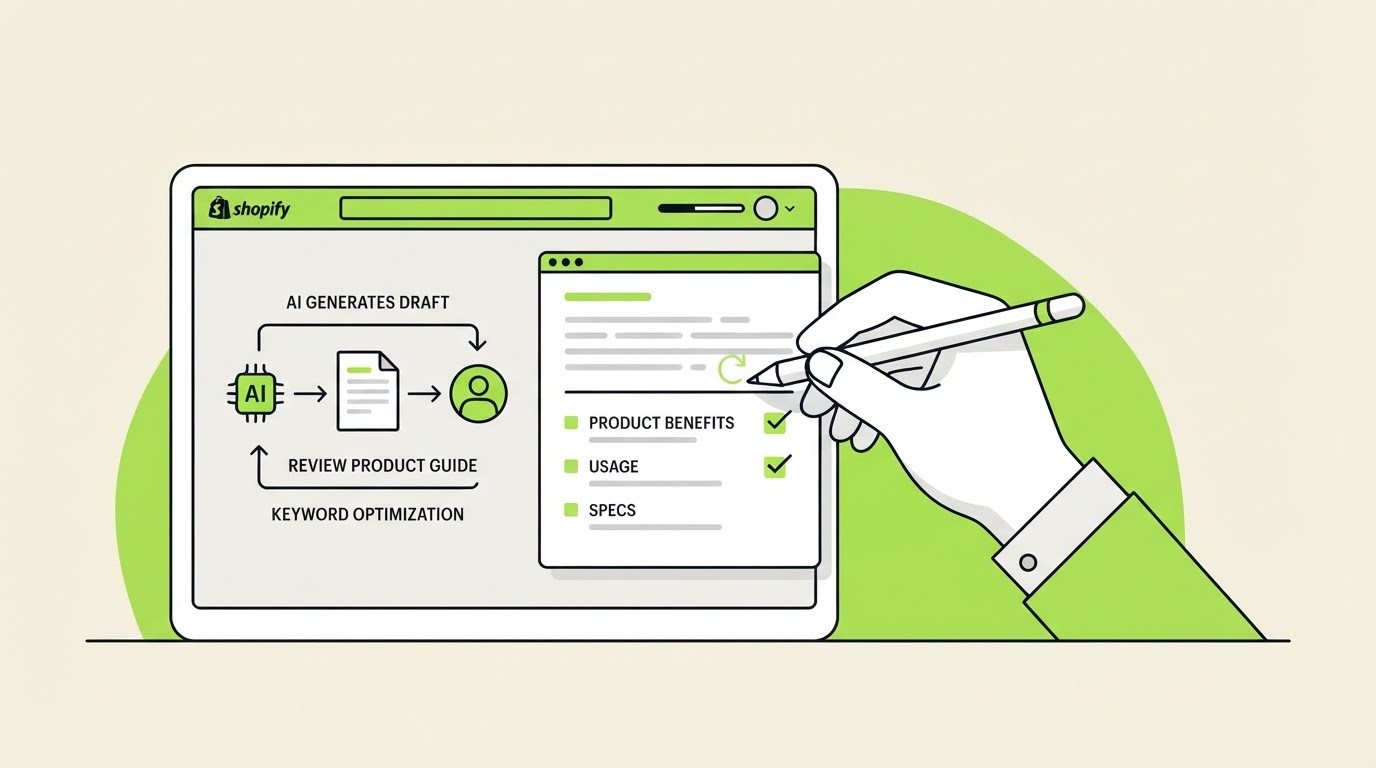
Draft the guide around the buying decision, then add product mentions where they solve a stated need. A Shopify AI blog writer can organize research and produce a complete first draft quickly, yet editorial review remains essential for commerce content.
For the grinder guide, a useful structure is simple: answer the choice question, explain the five selection criteria, match types of buyers to suitable features, show care requirements, and direct readers to the relevant collection. Add a short FAQ based on real support questions.
Review each draft in four passes. First, validate specifications against current product records. Second, test every internal link and ensure each linked product remains available. Third, remove vague phrases that reveal no buying criterion. Finally, ask a support team member whether the article could prevent a common pre-purchase question.
A frequent failure occurs when a draft recommends a discontinued grinder because an old comparison source remained in the research set. Maintain a current product source document and make availability verification part of the publishing checklist.
Use descriptive headings and concise answer paragraphs. Google’s guidance on creating helpful, reliable, people-first content supports the same editorial discipline: clear purpose, expertise, and useful original information.
How Rankdesk supports Shopify buying guide publishing
Teams can run this process manually, though the handoffs between research, drafting, review, publishing, and reporting often slow the schedule. Rankdesk brings those stages into one workflow while leaving product facts and editorial approval with your team.
Start by connecting the store through the Shopify integration. Rankdesk can use your site context, target topics, and competitor research to shape an article plan around a defined search opportunity.
Next, give the project the product knowledge collected from merchandising and support. Use that material to guide the brief, including the shopper profile, comparison criteria, page intent, and pages that deserve internal links. This keeps the draft grounded in the store’s actual catalog.
Then review the generated guide before publication. Check current specifications, edit recommendations, add any original photos or demonstrations, and confirm the selected Shopify category and product destinations. Publish when the page meets your editorial standard, or use an approved publishing workflow for repeatable content operations.
After publication, use Rankdesk’s AI Search Optimization capabilities alongside search performance data to identify which guides gain visibility and where content gaps remain. The goal is a maintained library of useful purchasing resources, rather than a one-time batch of posts. The wider process is covered in How to Automate SEO Content Creation: A Practical Workflow.
Publish Shopify buying guides with search-ready details
Before publishing, set the URL, SEO title, meta description, featured image, article tags, and internal links in Shopify. Keep the URL short and topic-specific. For the espresso example, /blogs/coffee-guides/how-to-choose-an-espresso-grinder clearly signals the page purpose.
Use a title that matches the decision the reader is making. A title such as “How to Choose an Espresso Grinder for a Small Kitchen” aligns with the article’s angle better than a broad brand-led title.
Add links from related collection pages, relevant product pages, and older educational posts where appropriate. These links help shoppers find the guide and clarify the relationship between informational and commercial pages. Build links because they help a real buyer move through the store.
Submit or inspect the page in Google Search Console after publication. Google’s Search Console documentation explains how to view indexing status and search performance reports. Track the guide as a distinct URL so its impressions and clicks remain visible over time.
Track Google rankings and AI citation visibility for Shopify guides
Measure progress in stages. New guides may first gain impressions for long, specific queries before they earn steady clicks. Search performance should be interpreted with the guide’s purpose in mind: a pre-purchase article may assist revenue through product-page visits rather than receive direct last-click credit.
For the grinder guide, monitor impressions and clicks for the target topic, rankings for decision-focused terms, clicks from the article into the grinder collection, and product-page visits that follow. Add a UTM-free internal analytics view if your platform supports path analysis, since internal navigation should stay clean for shoppers.
AI citation visibility deserves its own review. Test a small, stable set of buyer prompts that closely match the guide’s purpose, record which sources appear, and repeat the checks on a regular schedule. Look for accurate product entities, direct supporting passages, and pages that answer a narrow question well. The practical content patterns behind this work appear in How to Get Mentioned by ChatGPT: A Practical Content and Entity Guide.
Refresh the page whenever a model leaves the catalog, a specification changes, or Search Console shows growing impressions with weak clicks. In the latter case, revise the title and opening answer to better meet the query. When readers reach the guide yet rarely visit products, strengthen the use-case recommendations and links near the relevant criteria.
FAQ
Can a Shopify AI blog writer publish directly to my store?
A connected publishing workflow can send approved articles to Shopify. Review product claims, product URLs, collection placement, and publication settings before the article goes live. Ecommerce pages change frequently, especially when inventory and product details shift.
What kind of Shopify blog posts are most likely to support product sales?
Buying guides, product comparisons, use-case guides, sizing explainers, care guides, and compatibility articles often support product discovery because they answer questions that arise before purchase. Choose topics that connect naturally to a real collection or product page.
How long should a Shopify buying guide be?
Write until the buyer can make an informed next decision. A narrow compatibility question may need a short guide, while a category purchase with several criteria can require a more detailed resource. Specific evidence and clear structure carry more value than length alone.
Can product guides earn citations in AI assistant answers?
They can improve the likelihood when they provide accurate, distinct, well-structured information that answers a specific question. Citation behavior varies by assistant, prompt, available sources, and product knowledge. Keep facts current and give each guide a clear subject.
How often should I refresh Shopify buying guides?
Review product guides whenever catalog changes affect recommendations. Run a scheduled review every few months for important pages, then use Search Console and conversion behavior to prioritize deeper updates. Product specifications, availability, and customer questions should drive the refresh schedule.
If your Shopify store needs a consistent way to turn product knowledge into guides that support search visibility, see how Rankdesk works. It helps research your site, competitors, and keywords, then creates articles and landing pages your team can review or publish through an approved workflow.