
How to Get Mentioned by ChatGPT: A Practical Content Guide
October 5, 2026

A useful page can rank in Google and still fail to appear when someone asks ChatGPT for recommendations. The usual causes are vague brand information, thin articles, inaccessible pages, and no clear evidence that supports the claims.
Rankdesk helps teams research, create, review, and publish search-focused content, including articles designed to build the topical evidence behind AI search visibility. No publishing tactic can guarantee a ChatGPT mention, since the response depends on the prompt, available sources, and the system's retrieval choices.
Quick answer: how to get mentioned by ChatGPT
Use this workflow to improve your chances of earning relevant mentions:
- Define one clear entity page that states who you are, what you offer, who it serves, and where you operate.
- Publish source-backed pages that answer specific questions better than generic overview content.
- Build a connected topic cluster around the problems, comparisons, methods, and use cases people ask about.
- Make every important page crawlable, indexable, internally linked, and technically readable.
- Use clear headings, concise answers, tables, citations, author information, and relevant structured data.
- Refresh pages when your offering, source material, or search demand changes.
Start with clear entity information
ChatGPT needs enough context to associate your brand with a category, audience, and area of expertise. Give it consistent facts across the pages you control.
Create a strong About page, then reinforce the same core description on your homepage, service pages, author bios, and contact details. Include the legal or trading name where relevant, the specific service categories, locations served, founding or operating context, and qualified team credentials.
For example, a bookkeeping firm should say "monthly bookkeeping and cash-flow reporting for U.S. ecommerce businesses" rather than relying on "financial solutions for growing companies." The first description supplies concrete relationships that a reader, crawler, or retrieval system can use.
Use schema where it accurately reflects the page. Google's structured data documentation explains how structured data helps search engines understand page information. Add Organization, LocalBusiness, Person, Product, Service, Article, or FAQ markup only when the visible page content supports it.
Worked example: Ledger Lane Advisory
Consider a fictional firm at ledgerlane.example. Its homepage originally calls the business a "trusted finance partner," while its services page mixes bookkeeping, tax preparation, payroll, and CFO consulting into one short paragraph. A ChatGPT user asks, "Which firms help Shopify stores clean up inventory accounting?" The site provides little evidence for a specific answer.
Ledger Lane rewrites its entity information around a narrower position: inventory accounting and monthly close support for Shopify brands with multi-channel sales. It adds a detailed service page at /shopify-inventory-accounting/, an About page naming the firm's credentials, and author bios for its accountants. This gives later content a precise entity to reference.
Publish source-backed pages that deserve a ChatGPT mention
Pages earn inclusion when they provide an answer that is useful, specific, and easy to verify. Write for the real question behind the prompt.
For Ledger Lane, a stronger article could be /blog/shopify-inventory-accounting-guide/. It explains how returns, bundles, landed costs, and marketplace fees affect the monthly close. The article cites primary materials from Shopify and relevant accounting standards where they support a factual claim. It also identifies which advice is the firm's practical recommendation.
Separate evidence from opinion in the writing. Link to original regulations, platform documentation, research, standards, or product documentation whenever a reader needs to verify a claim. Avoid stacking generic outbound links that add no support.
Use this page structure for important informational content:
- Give a direct answer within the opening paragraphs.
- Explain the process in ordered steps with concrete conditions.
- Cite the primary source beside the claim it supports.
- Add examples, limits, and decisions readers face in practice.
- State the author, reviewer, and date when subject expertise is relevant.
For ChatGPT-related discovery, factual freshness carries weight. Update source links after platform changes, revise dated screenshots, and remove guidance that no longer applies. A page with old instructions can weaken trust across the whole topic cluster.
Build topical depth around the questions ChatGPT users ask
One excellent page rarely establishes broad expertise by itself. Build related pages that cover the decision paths surrounding the core service or product.
Ledger Lane's first draft fails here. Its inventory guide mentions Shopify bundles and Amazon settlements, yet neither subject has a supporting page. The firm publishes two follow-up articles: /blog/shopify-bundle-cogs/ and /blog/amazon-settlement-reconciliation/. Each article links back to the main guide with descriptive anchor text, and the guide links out to both pages where the subjects arise.
This internal structure helps readers move from a broad question to a specific implementation question. It also shows that the site has sustained coverage instead of a single isolated article.
Plan clusters from real search and sales questions. Your list should include beginner questions, implementation problems, comparison decisions, troubleshooting topics, and service-specific outcomes. The workflow in Automated SEO Content for Topic Clusters provides a useful model for turning that map into connected pages.
| Content type | Example for Ledger Lane | Purpose in an AI search response |
|---|---|---|
| Entity page | Shopify inventory accounting service | Connects the firm to a defined service and audience |
| Definitive guide | Shopify inventory accounting guide | Answers the broad educational question |
| Problem page | How to reconcile Amazon settlement reports | Covers a specific operational issue |
| Comparison page | Inventory accounting software for Shopify brands | Helps users evaluate options |
| Evidence page | Monthly close checklist for multi-channel sellers | Supplies a reusable, detailed reference |
Keep each page distinct. Rewording the same article for closely related phrases produces repetitive coverage and weakens editorial value. Give every URL a separate job in the reader's decision process.
Make pages crawlable for ChatGPT search and other AI systems
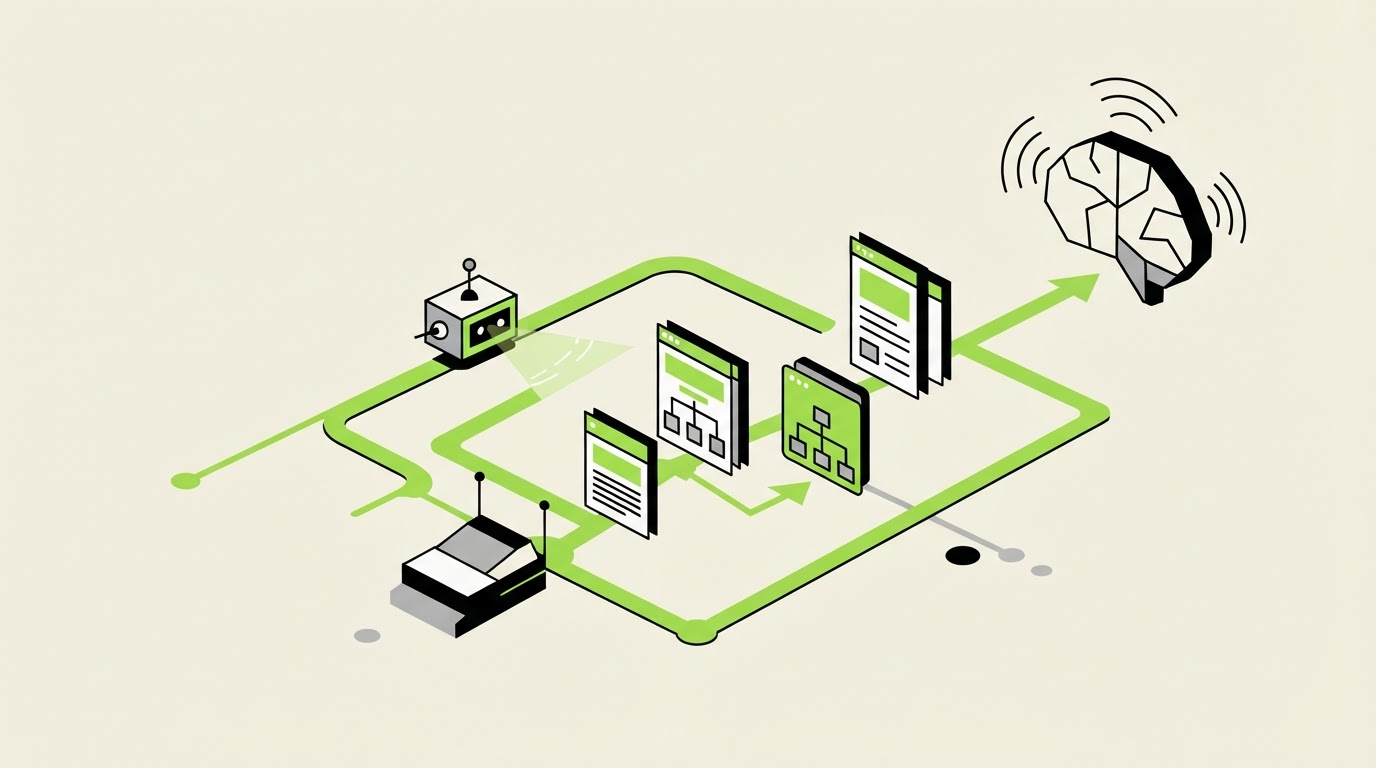
A strong article needs technical access before it can become a usable source. Confirm that important URLs return a successful status code, load meaningful HTML, and have a self-referencing canonical URL where appropriate. Add them to your XML sitemap and link to them from crawlable pages.
For ChatGPT search visibility, review the OpenAI guidance for OAI-SearchBot and other OpenAI crawlers. OAI-SearchBot is the crawler associated with surfaced search results. Check your robots.txt, CDN rules, firewall settings, and bot protection configuration before assuming access is available.
Indexing and crawling should also support the Google ecosystem that supplies much of the searchable web. Use Google Search Console to inspect key URLs, find indexing problems, and monitor whether a redesigned page is actually discoverable.
For Ledger Lane, the inventory guide has an avoidable failure: its migration places the canonical tag on an old generic bookkeeping page. Search engines receive conflicting signals about the preferred URL. The team corrects the canonical, adds the guide to the XML sitemap, and places internal links from the Shopify bookkeeping service page and the blog hub.
Run this technical check before publishing a cluster:
- Test the live URL without a logged-in session.
- Inspect the rendered page for the main body copy and internal links.
- Verify the canonical URL points to the intended page.
- Check that
robots.txtand security tools allow appropriate search crawlers. - Submit or refresh the XML sitemap after major additions.
- Inspect priority URLs in Search Console.
Use content formats AI systems can understand and quote
Retrieval systems work best with direct, well-labeled information. Put the answer immediately below a descriptive H2 or H3. Define specialist terms on first use. Use short paragraphs around a single claim.
Tables work well for comparisons when the criteria are genuine. Ordered steps work well for procedures. A concise FAQ can capture natural-language questions that readers ask before taking action. Keep the format faithful to the material instead of adding sections solely for markup.
For example, Ledger Lane adds a section titled "How should Shopify stores account for product bundles?" It starts with a two-sentence answer, then explains the allocation method, data required, and a worked scenario. That passage can stand on its own when a system retrieves it for a focused prompt.
Avoid unsupported superlatives, anonymous expert claims, and pages that bury the answer below long promotional copy. AI assistants need clear material they can attribute and summarize responsibly.
How to use Rankdesk and WordPress for ChatGPT-ready content
A consistent publishing system makes this work easier to repeat. Rankdesk supports a practical workflow from research through publication, while its WordPress integration supports delivery to a WordPress site.
Start by defining the core service or product topic, such as Shopify inventory accounting. Rankdesk researches your site, competitors, and relevant keywords to shape a content brief around the questions and coverage gaps that matter.
Next, create the pillar article and supporting pages. Review every factual claim, add first-party experience from your team, and insert links to primary sources where needed. For Ledger Lane, the reviewer supplies the real monthly-close sequence and removes a broad claim about tax treatment that varies by jurisdiction.
Then set internal links before publishing. Link the guide to the service page, the bundle-cost article, the Amazon settlement article, and the author bio. This gives readers a useful path and makes the topic relationship explicit.
Finally, publish the approved content to WordPress, check the live HTML and indexability, then track the pages in Search Console. The broader Rankdesk AI search optimization approach connects content production with the technical and editorial work that supports AI citations.
Teams handling higher volume should also use an editorial gate before automated publication. The pre-publishing quality checklist covers the source review, brand accuracy, metadata, links, and technical checks that protect quality at scale.
Common mistakes when trying to get mentioned by ChatGPT
The biggest mistake is treating a mention as a one-page optimization task. A credible answer depends on the combined signals from entity clarity, useful pages, technical availability, source quality, and ongoing maintenance.
Another failure mode is publishing generic articles across dozens of adjacent subjects. Ledger Lane would lose focus by producing shallow pages about every accounting niche. It should deepen its ecommerce accounting coverage first, then expand only where it has expertise and supporting evidence.
Also avoid blocking useful crawlers accidentally. Consent tools, JavaScript-only rendering, staging rules copied to production, and aggressive bot filtering often hide content from systems that need to access it.
FAQ
Can you guarantee that ChatGPT will mention your business?
No. ChatGPT responses vary by prompt, search availability, source selection, and product behavior. Build pages that are accurate, crawlable, and genuinely useful so your brand has stronger source material available for relevant questions.
Does ranking in Google help you get mentioned by ChatGPT?
Google visibility can support discovery because high-quality, accessible pages attract links, readers, and search traffic. ChatGPT mentions require their own source selection, so maintain strong entity information, direct answers, and technical accessibility across the site.
Should I allow GPTBot to crawl my website?
Review OpenAI's crawler documentation and make a deliberate decision with your legal, privacy, and content teams. OAI-SearchBot relates to ChatGPT search visibility, while GPTBot has a separate purpose described in OpenAI's guidance.
How often should I update content for AI search visibility?
Review priority pages whenever your product, service, regulations, or cited source material changes. For evergreen guides, schedule a periodic editorial review and check Search Console for pages that lose impressions or develop indexing issues.
Do citations from authoritative sources improve ChatGPT mentions?
Source-backed content gives readers and retrieval systems material they can assess. Cite primary sources for factual claims, while keeping your practical interpretation clearly labeled as your own guidance.
If you want a repeatable way to build crawlable, source-backed topic clusters for AI search, see how Rankdesk works. It researches your site, competitors, and keywords, then creates articles and landing pages you can review or publish automatically.
Want articles like this on your site?
Rankdesk plans, writes and publishes SEO content for you. Start free and generate your first 3 articles.