
Ghost AI Content Writer: Use Rankdesk to Rank and Earn AI Citations
September 23, 2026

A Ghost publication can have excellent writing and still miss organic traffic because articles target broad topics, answer the query too late, or sit unpublished in drafts. It can also be hard for ChatGPT, Claude, and similar assistants to use a page when its claims, authorship, and internal context are vague.
Rankdesk gives Ghost owners one workflow for researching topics, producing structured drafts, reviewing them, and sending approved work to the CMS. Start with the Rankdesk Ghost integration, then treat every published article as a useful, attributable source rather than a page built only to contain keywords.
Quick answer: how to use a Ghost AI content writer workflow
Use this workflow to create and publish articles from Rankdesk to Ghost:
- Connect your Ghost site in Rankdesk with the site URL and the credentials required for publishing.
- Choose a narrow search topic based on your site, competitors, and a clear reader question.
- Generate an article brief that specifies the audience, search intent, evidence needed, and internal pages to link.
- Create the draft, then edit claims, examples, headings, metadata, and author details before approval.
- Publish to Ghost as a draft or live post, depending on your editorial controls.
- Add internal links, clear source attribution, and a direct answer near the top so search engines and AI assistants can interpret the page.
- Check indexing and update pages that earn impressions but fail to satisfy the query.
Connect Rankdesk to Ghost before creating articles
Set up the connection before building a content queue. That prevents a common operational failure: a team creates dozens of drafts, then discovers the publishing account cannot access the intended Ghost publication or cannot create the needed posts.
In Ghost, create the integration and use credentials with only the permissions required to create and update posts. Keep the key in Rankdesk rather than pasting it into briefs or shared documents. Ghost explains how its Admin API authentication works in its official Admin API documentation.
Then decide how publishing should work:
| Publishing choice | Best use case | Control point before a post goes live | Main risk |
|---|---|---|---|
| Send as draft | New site, regulated topic, or new editorial process | Editor checks every field in Ghost | Slower publishing if drafts pile up |
| Publish after approval | Established topics with a reliable review template | Approval happens in Rankdesk before sending | A weak template can repeat errors at scale |
| Scheduled publishing | A reviewed backlog with a fixed cadence | Editor verifies dates, seasonality, and linked offers | Time-sensitive advice may be stale on publish day |
For a first connection, send one post as a draft. Confirm its title, slug, feature image, tags, excerpt, canonical settings, and author display correctly in Ghost. Only then use automatic publication for a narrow set of low-risk article types.
Worked example: an insulation contractor's Ghost site
Consider a fictional contractor, Northstar Home Insulation, with its blog at northstarinsulation.com/blog. The site has a service page for attic insulation but no article that answers whether blown-in insulation works in an older home.
The initial topic is not simply “blown-in insulation.” That is too broad. The brief targets the question behind the search: “Is blown-in insulation suitable for a 1950s attic?” The article links to /attic-insulation/, explains when an inspection is necessary, and avoids promising suitability without seeing wiring, moisture, or ventilation conditions.
That creates a page with a definable purpose. It is more useful in Google results and more defensible as a potential source in an AI-generated answer.
Create Ghost articles around one search question
A Ghost AI content writer workflow should begin with the question a reader needs answered, not a title guessed from a keyword list. Export the last 90 days of Search Console queries first. Group terms that indicate the same intent, then select the query where your site can provide specific first-hand context or a well-supported explanation.
For Northstar, the selected article needs to answer suitability, not teach every insulation method. The brief should require these elements:
- A direct answer in the first 100 to 150 words, with conditions and limits.
- A decision path covering attic access, existing insulation, moisture, electrical hazards, and local code checks.
- Plain definitions for blown-in cellulose and fiberglass.
- A link to the relevant service page and related maintenance guidance.
- Citations for technical or safety claims that go beyond the company's own experience.
Give the draft an explicit editorial role. Ask it to distinguish observed service advice from information drawn from public standards or manufacturer guidance. Do not allow it to imply that a site visit happened when it did not.
For the full research-to-review process, use this guide to an AI writer for SEO articles. It is especially helpful when several people approve briefs and final Ghost posts.
Structure Ghost posts so Google and AI assistants can use them
Google and AI assistants do not need identical formatting rules, but both benefit when a page is easy to parse and clearly connected to a real publisher. Google’s SEO Starter Guide supports the basics: useful people-first content, descriptive titles, and links that help users and crawlers understand a site.
For every Ghost post, use one descriptive H1, then organize the answer with H2s that match the decisions a reader must make. Put the concise answer first. Follow it with qualifications, process details, and sources.
On the Northstar article, the opening might state that blown-in insulation can work well in many older attics, but the existing insulation, moisture condition, wiring, and ventilation must be assessed first. That sentence answers the query without claiming a universal result. The next H2 explains those checks one at a time.
Add author and publisher information that is consistent across the site. Link to an author page or company about page when available. Use a visible updated date when the article has genuinely been reviewed. These details will not force an AI assistant to cite the article, and no platform can guarantee a citation. They do make the source easier to assess.
Use internal links as context, not decoration. A link from the older-home insulation article to the attic insulation service page explains the commercial relationship. A link to a moisture-control guide shows the site has supporting coverage. Read how to get mentioned by ChatGPT for a deeper explanation of entity clarity, source quality, and citation-ready content.
How Rankdesk handles the Ghost publishing workflow
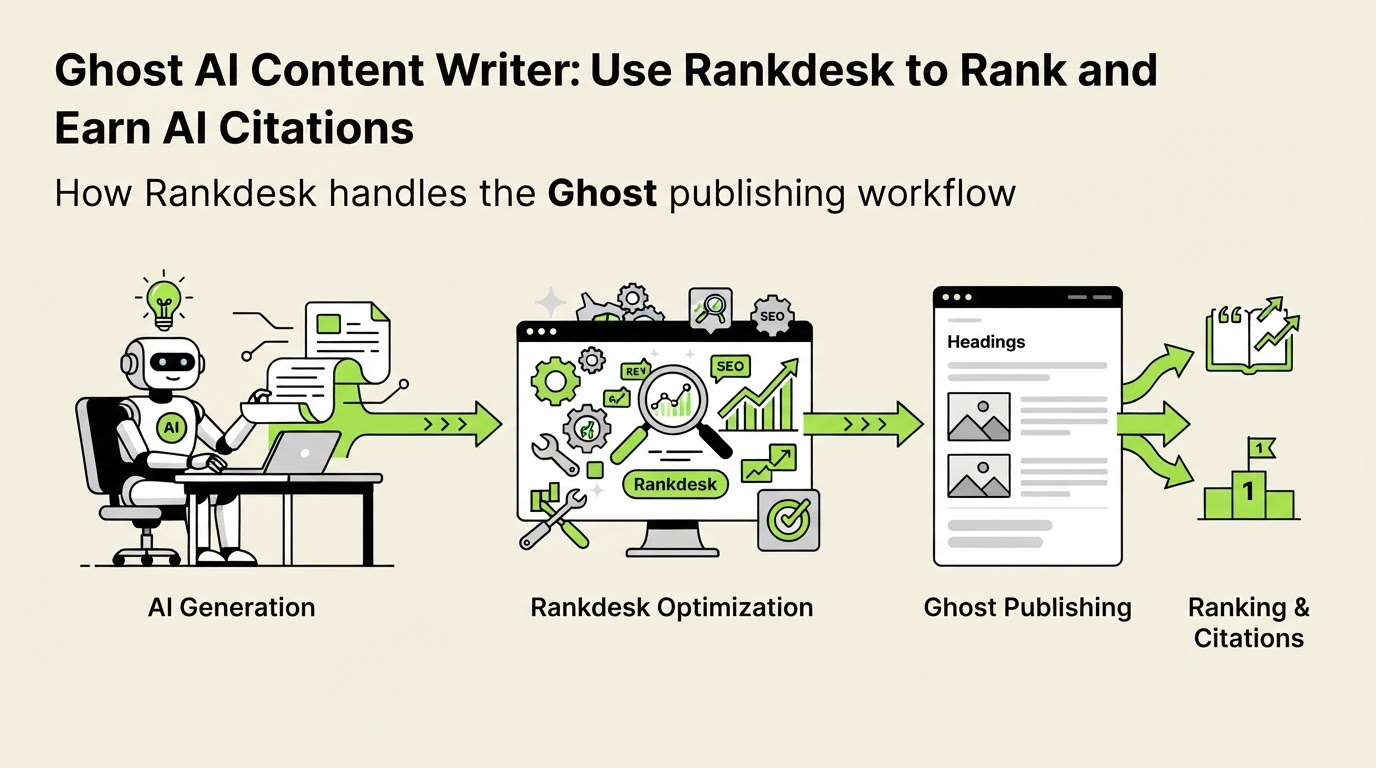
Doing this manually often means moving between keyword notes, a document editor, a CMS, and a spreadsheet of publication dates. Rankdesk reduces those handoffs while retaining a review point where it matters.
First, add the Ghost domain so Rankdesk can use your site as context. Next, select a topic and have the workflow research relevant keywords, your existing pages, and competing coverage. For Northstar, that means identifying that the attic service page already exists and that the new article should support it rather than compete with it.
Then generate the article from the approved brief. Review the sections that carry the most risk: the direct answer, factual claims, product or service statements, and links. Correct vague phrases such as “always saves money” and replace them with conditions a homeowner can act on.
After approval, choose the Ghost connection and publishing status. Send the first article to drafts, inspect the rendered post, and establish a repeatable standard. Once the workflow is proven, publish approved pieces automatically where the topic and review rules justify it.
This is the practical value of Rankdesk's AI search optimization approach: the article is planned as a source with a specific query, supporting entities, clear answers, and a place within the rest of the site, rather than as isolated text.
Check every Ghost post before it publishes
Automation can reproduce strengths, but it can also reproduce a bad assumption 20 times. Northstar's first draft illustrates this well: it treated all older attics as comparable. The editor caught that knob-and-tube wiring and active roof leaks require a different recommendation, so the draft was revised to make inspection the first step in those situations.
Use a short pre-publication check. Verify that the title matches the actual question, the opening answer includes sensible limits, every internal link works, and factual claims have a source or are clearly framed as the business's own guidance. Also check that the slug does not duplicate an existing post and that the excerpt gives a reader a reason to open the result.
Do not publish a post merely because the draft reads smoothly. Check it against the search results and your existing pages. If another page already answers the same question, consolidate or refresh instead of creating two weakly differentiated URLs. The automated SEO content quality checklist provides a useful final review process for this step.
Measure rankings and citation readiness after publication
Submit or confirm the new URL in Google Search Console, then give it enough time to collect impressions before making large changes. Look for mismatches between the queries producing impressions and the answer on the page. If Northstar's article appears for “blown-in insulation cost,” but does not include a cost section, it should not add a generic price range simply to chase the query. It should either write a separate, locally grounded cost article or stay focused on suitability.
Track these signals over time:
- Impressions and clicks for the primary question and close variants.
- Queries where the page ranks but has a low click-through rate.
- Internal pages receiving traffic from the article.
- Mentions of the brand or URL in relevant AI assistant responses, tested with consistent prompts.
- Editorial changes made after technical, regulatory, or product updates.
AI assistant citations vary by system, prompt, geography, retrieval sources, and time. Treat them as an outcome of credible, accessible, specific publishing, not as a switch you can turn on. Publishing useful Ghost pages also strengthens the body of evidence a site has for future search visibility.
FAQ about using Rankdesk with Ghost
Can Rankdesk publish directly to Ghost?
Rankdesk supports Ghost through its Ghost integration. Start by sending posts as drafts so you can verify how your theme renders headings, images, excerpts, tags, and author information. Move to automatic publication only after the connection and editorial checks are working as expected.
Will a Ghost AI content writer get my site cited by ChatGPT or Claude?
No tool can promise citations from ChatGPT, Claude, or any other assistant. The useful goal is to publish clear, accurate pages with a direct answer, identifiable publisher information, appropriate sources, and strong topical connections across your site. Those qualities improve the chance that a page can be found and assessed.
Should I publish every generated article immediately?
No. Review new topic clusters manually until you know the brief rules are producing accurate, differentiated work. Automatic publishing is most suitable for formats with stable facts, clear templates, and a proven review process.
How often should I publish Ghost articles for SEO?
Publish at the pace your team can research, edit, and maintain. Three well-targeted articles that support important service pages are more useful than frequent posts that repeat the same vague advice. Expand the backlog only after you can verify quality and update published work.
If you want a more consistent way to plan, write, and publish search-focused Ghost articles, see how Rankdesk works. It researches your site, competitors, and keywords, then creates articles and landing pages you can review or publish automatically.
Want articles like this on your site?
Rankdesk plans, writes and publishes SEO content for you. Start free and generate your first 3 articles.