
AI Writer With Search Console Integration: Turn Performance Data Into Better Content
September 2, 2026

A page can rank for 80 relevant queries and still receive little traffic because it answers the wrong subtopics, uses a weak title, or sits just below the results people click. Publishing another article without checking those signals often creates overlap instead of growth.
An AI writer with Search Console integration turns real query, page, impression, click, position, country, and device data into practical content decisions. Rankdesk can support this workflow by connecting performance-led research with writing and publishing instead of treating each stage as a separate task.
Quick answer: How to use an AI writer with Search Console integration
Use this workflow to turn Google Search Console data into new and updated content:
- Connect the verified Search Console property for the site you want to improve.
- Export at least the last 90 days of query and page performance data.
- Separate existing-page opportunities from queries that need new pages.
- Prioritize topics using impressions, position, relevance, and conversion value.
- Give the AI writer the selected queries, page context, and required changes.
- Review the draft for accuracy, search intent, internal links, and unsupported claims.
- Publish or schedule the page, then compare its query performance after Google recrawls it.
The process starts with evidence from your own site. That makes it more useful than choosing topics solely from generic keyword databases.
How an AI writer with Search Console integration works
Google Search Console records how pages appear in Google Search. Its performance report provides clicks, impressions, click-through rate, and average position, with dimensions such as query, page, country, device, and date. Google explains the available metrics and report behavior in its official Search performance report documentation.
The integration should pass those signals into the content workflow without treating them as writing instructions by themselves. A query with many impressions does not automatically deserve a new article. It may belong on a page that already ranks, or it may be too broad for the site's products and readers.
Consider a hypothetical specialty coffee equipment site with this existing guide:
https://northstarcoffee.example/guides/aeropress-grind-size
Its Search Console export contains queries around AeroPress grind settings, water temperature, steep time, and settings for light-roast coffee. The page already discusses grind size thoroughly, but mentions light roasts in one sentence and gives no temperature guidance.
A basic keyword tool might recommend four articles. Search Console suggests a different decision: strengthen the page that Google already associates with those closely related needs. That preserves one clear URL and reduces the risk of several pages competing for the same searches.
A useful integration therefore performs three jobs. It identifies a measurable opportunity, retrieves enough page context to understand what already exists, and gives the writer constraints that reflect the desired outcome. The generated draft should add missing value rather than repeat the current page with different wording.
Export Search Console data before asking the AI writer for topics
Export the last 90 days first. This range usually gives enough observations to reduce the effect of a brief ranking fluctuation while remaining relevant to the current site.
Then compare it with a longer period when the business is seasonal or the page has existed for more than a year. Search Console allows users to view up to 16 months of performance data in the interface. A coffee gift guide, tax article, or summer travel page needs that longer context because a quiet recent period may be normal.
Choose the Search type that matches the content. Web Search is the usual starting point for articles and landing pages. Image and video data should be reviewed separately because their impressions and click behavior reflect different result formats.
Apply filters before interpreting the export. Branded searches can make a weak non-branded page look healthy. A company ranking first for its own name does not prove that its educational content reaches new readers. Country filters also matter when products, regulations, spelling, or delivery areas differ by market.
For the coffee example, start with the page filter for /guides/aeropress-grind-size. Review its queries, then run a second export for all URLs in /guides/. The page-level view reveals sections to improve. The directory-level view helps detect whether another guide already covers the same intent.
Keep these fields together during analysis:
- Query and landing page
- Clicks and impressions
- Click-through rate and average position
- Date range and comparison period
- Country and device filters
- Whether the query is branded or non-branded
Do not combine exports from different filters without labeling them. A mobile-only query set compared with all-device page data can produce misleading priorities.
How to find content gaps with Search Console data
A Search Console content gap is a relevant need that Google already associates with the site but that the current page does not answer adequately. It is different from a general market gap found through competitor or keyword research.
Start by grouping queries by intent rather than by matching words. In the coffee example, “AeroPress grind for light roast” and “light roast AeroPress setting” likely belong to the same section. “Best grinder for AeroPress” is commercial and may deserve a separate comparison page. “AeroPress filters near me” is local and probably falls outside the guide's purpose.
The following decision table turns common Search Console patterns into specific actions.
Search Console patternLikely issueRecommended content actionMain riskHigh impressions, position 4 to 15, low clicksSnippet or intent mismatchImprove the title, introduction, answer placement, and relevant sectionsChanging a title that already performs for stronger queriesSeveral related queries lead to one thin sectionIncomplete topic coverageExpand that section with concrete instructions and examplesAdding repetitive text without new informationA relevant query has impressions across several URLsKeyword cannibalization or unclear page rolesSelect one primary URL and consolidate or differentiate the othersRedirecting a page with distinct valueQueries show a distinct intent that the ranking page cannot satisfyMissing pageCreate a focused article or landing page and link it to the existing resourceProducing a near-duplicate pagePosition and clicks fell after the page became outdatedContent decayVerify facts, replace obsolete steps, and update examplesChanging content before checking seasonality or technical issuesStrong position but weak click-through rateUncompetitive search snippetRewrite the title and description around the actual answerPromising something the page does not deliver
Open the ranking page while classifying each cluster. Search Console reports what happened in Search, but it does not tell you whether the answer is absent, buried, inaccurate, or simply phrased differently.
For /guides/aeropress-grind-size, the light-roast cluster belongs on the current page because grind size changes with roast level and brewing method. The grinder comparison cluster deserves a different URL because readers are choosing equipment rather than adjusting a recipe.
This is also where an AI writer needs guardrails. Give it the current URL, the selected query cluster, the sections that must remain, and the new information required. A vague prompt such as “improve this for SEO” encourages broad rewriting and may remove details that already support rankings.
How to refresh underperforming pages with an AI writer
A refresh should begin with diagnosis. Position, impressions, clicks, and page content need to be considered together.
If impressions are rising while position remains stable, demand may be increasing and no major rewrite is necessary. If average position improves but clicks do not, inspect the title, snippet, and result-page competition. When both impressions and position decline, check whether competing results answer a changed intent or whether the page has become outdated.
Google calculates average position using the topmost result from the property for each impression. That metric is useful for trends, but it should not be interpreted as a fixed daily rank. Segment the data by query and page before making structural changes.
For the coffee guide, preserve the grind-size chart if it already attracts impressions and links. Add a clearly labeled light-roast subsection, explain why a finer setting may help extraction, and include a starting recipe with variables the reader can adjust. Add temperature guidance only where it affects the grind recommendation. Do not turn a grind guide into a complete AeroPress encyclopedia.
Give the AI writer source material for factual claims. Product documentation, original testing notes, expert review, and first-party business knowledge are better inputs than generated assertions. Where a claim cannot be verified, remove it or phrase it as a variable to test rather than a universal rule.
The draft should also retain the page's URL unless there is a strong reason to change it. Updating the slug during a routine refresh creates redirect work and can temporarily disturb performance. If the URL must change, implement a permanent redirect and update internal links.
For a fuller editorial process, use the review stages in this AI writer workflow for SEO articles. Search Console selects the opportunity, while editorial review protects accuracy and usefulness.
Prioritize SEO topics using real search performance
A long export can contain thousands of rows. Sorting by impressions alone puts broad, low-value terms at the top, while sorting by clicks favors pages that already work.
Create a simple priority score based on four factors: existing visibility, realistic ranking reach, business relevance, and the amount of content work required. The score does not need to be mathematically sophisticated. Consistency matters more.
Use a 1-to-5 rating for each factor. Give higher scores to queries with meaningful impressions, positions within a plausible improvement range, a close relationship to the site's offer, and a clear fix. Reduce the final priority for pages that need product testing, legal review, original photography, or extensive subject-matter input that is not yet available.
The coffee site's light-roast cluster has existing impressions, fits the page, and can be addressed with a focused addition. It should come before a broad topic such as “how to make better coffee,” even if that phrase has greater estimated search volume elsewhere.
Prioritization should also distinguish three types of work:
- Quick refreshes that improve headings, answer placement, or missing subsections
- Substantial rewrites where intent is correct but the page is no longer competitive
- New pages for distinct needs that no current URL can satisfy
Batch similar work together. Editing five established guides requires a different brief and review process from producing five new landing pages. Teams managing multiple sites can adapt the operational controls described in this guide to scaling SEO content for agency clients.
Turn Search Console queries into a useful AI writing brief
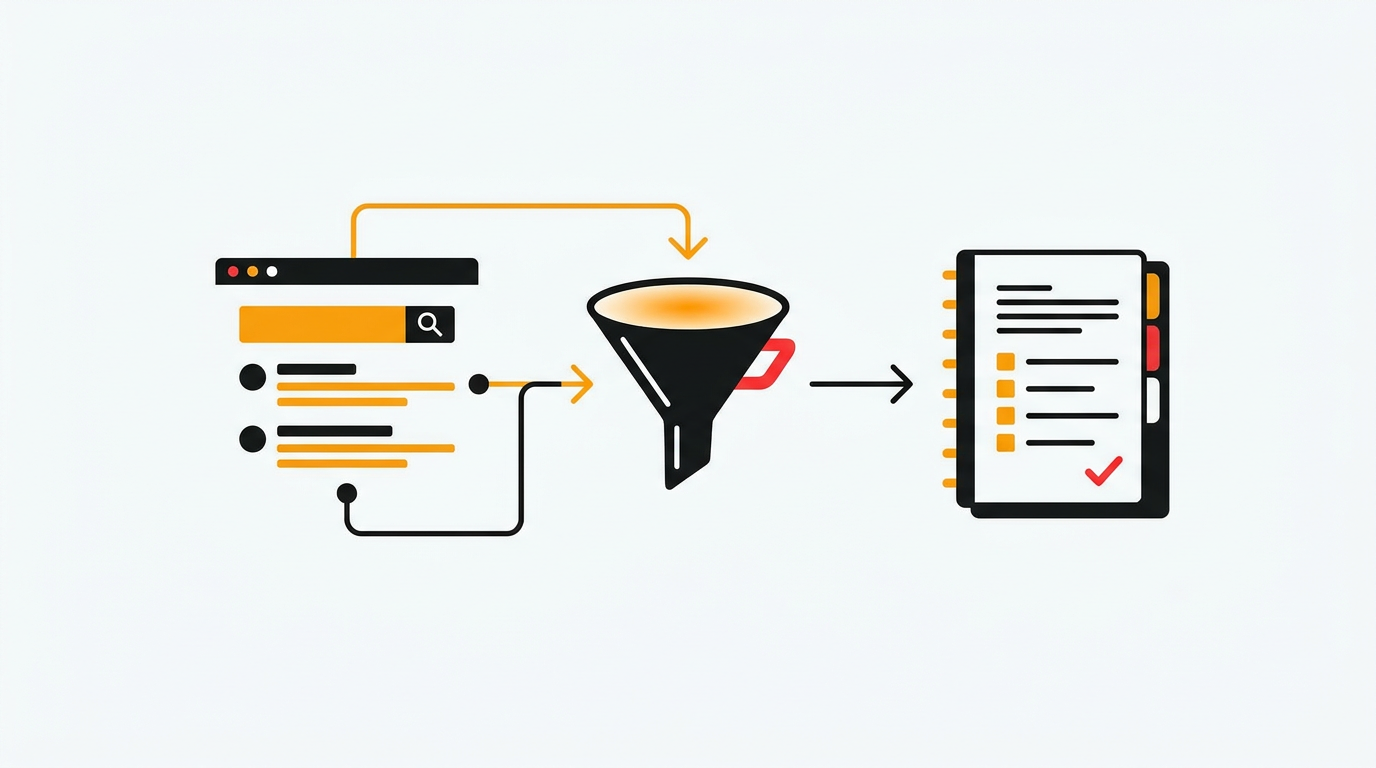
Raw queries make poor briefs. They contain fragments, repeated wording, spelling variants, and searches that may be unrelated to the desired page.
Convert the selected cluster into an editorial instruction. State who the page serves, what decision or task it should help with, which existing URL is involved, and whether the assignment is a refresh or a new page. Include current headings so the writer can preserve useful structure.
For the AeroPress page, a practical brief would ask for a new section on adjusting grind size for light-roast beans, supported by a starting recipe and troubleshooting notes. It would prohibit unrelated grinder recommendations and require the existing grind chart to remain.
Add the Search Console evidence as context, not as text to repeat. Include the representative queries, their landing page, the chosen date range, and any meaningful device or country pattern. Do not instruct the writer to place every query verbatim. Searchers use many forms to express one need.
A strong brief also defines the final checks:
- Every new factual claim has an identifiable source or first-party basis
- The opening answers the main search need quickly
- Existing high-performing sections remain intact unless evidence supports a change
- Internal links point to genuinely useful next steps
- The title reflects the page without overstating its coverage
- The page contains no invented testing results or customer outcomes
This approach works for articles, commercial pages, and repeatable landing-page templates. Programmatic pages need stricter data controls because one unsupported field can be reproduced across hundreds of URLs. The broader SEO content automation workflow explains where human approval should remain in a scaled publishing process.
How Rankdesk uses Search Console data in the writing workflow
Doing this manually requires exports, spreadsheets, page reviews, briefs, drafts, content management system access, and follow-up reporting. Rankdesk reduces the handoffs by keeping research, writing, and publishing in one workflow.
Start by onboarding the site and supplying the business and topic context needed for relevant content decisions. The Rankdesk process from onboarding to publication shows how the stages fit together.
Next, use Search Console performance to identify the pages and query clusters with a credible opportunity. In the coffee example, the workflow should recognize /guides/aeropress-grind-size as the existing destination for the light-roast cluster rather than creating a second article by default.
The research stage combines those first-party signals with the current page and broader search context. The assignment can then specify whether Rankdesk should create a new article or prepare an improved version of an existing resource. Its research, writing, and publishing features are designed to keep those decisions connected.
Review the generated page before publication. Check technical recommendations, product details, citations, and claims that depend on direct experience. For the example guide, an editor should confirm the recipe variables and ensure the new section does not contradict the existing grind chart.
After approval, publish through a supported destination such as WordPress, Shopify, or Lovable. The available Rankdesk publishing integrations remove copy-and-paste work while retaining the option to review content before it goes live.
This ordered workflow matters because automation should preserve the reasoning that produced the brief. A disconnected generator receives a keyword and creates text. A performance-led workflow starts with an observed search opportunity, chooses the correct URL, defines the missing information, and only then writes.
Publish AI-assisted content without losing quality control
Automatic publishing is useful when the inputs and approval rules are dependable. It is risky when a draft contains unverified claims, duplicates an existing page, or selects the wrong page type.
Set different approval requirements by content category. A basic educational article may need editorial review. A medical, financial, or legal page requires qualified subject review. Product specifications should be checked against the current catalog, regardless of how well the draft reads.
Google's guidance on AI-generated content focuses on content quality and purpose rather than banning a particular production method. Using automation primarily to manipulate rankings can still conflict with Google's spam policies. Publish pages because they satisfy a real need shown by the data.
Internal links deserve deliberate review. Link the refreshed AeroPress guide to a brewing-method hub and, where relevant, to a grinder comparison. Avoid forcing links to unrelated commercial pages. The anchor should describe what the reader gets next.
Search performance and visibility in AI assistants overlap in an important way. Clear explanations, stable URLs, specific entity information, and verifiable claims make a page easier to retrieve and cite. No workflow can guarantee a mention from ChatGPT or Claude, but a well-supported page gives retrieval systems more useful material than generic prose does. This guide to earning mentions from ChatGPT covers the entity and citation work beyond conventional keyword optimization.
Measure results after publishing the Search Console-led update
Record the publication date and the queries that motivated the change. Without that baseline, later comparisons tend to focus on whichever metric moved most favorably.
Allow time for Google to recrawl and reassess the page. Use Search Console's URL Inspection tool to confirm index status and inspect the canonical URL. Google's URL Inspection documentation explains what the live test and indexed-page information can show.
Compare equivalent periods when possible. A 28-day period after publication should not be compared with seven days before publication. Account for seasonality, branded campaigns, major site changes, and demand shifts.
Review the target query cluster first, then the full page. A section added for light-roast searches could improve those queries while weakening the page's primary AeroPress grind terms if the title was changed too aggressively. Both effects matter.
Clicks are usually the clearest business-facing Search Console metric, but they are not the sole measure. More relevant impressions may show that Google understands the expanded page before click volume grows. A stronger position with unchanged clicks may point back to the title or search intent. Track conversions in the site's analytics platform when the page has a commercial role.
Do not rewrite the page again after a few days. Frequent edits make it difficult to determine which change helped and can remove useful material before search performance settles.
Common mistakes with an AI writer and Search Console integration
The first failure mode is turning every query into a page. Search Console often lists several wordings of the same intent, so this approach creates thin, overlapping articles.
Another mistake is targeting queries simply because they have impressions. Google can test a page for searches that are peripheral to its purpose. Check business relevance and the visible results before committing resources.
Avoid rewriting entire pages when one section is missing. Broad rewrites can erase unique examples, internal links, and wording that already performs. Request a scoped edit whenever the evidence supports one.
Do not treat average position as a precise rank tracker. It aggregates impressions across locations, devices, dates, and result contexts. Segment before diagnosing.
Finally, do not publish unsupported claims because an AI writer presents them confidently. Search Console supplies demand signals, not factual validation. A subject expert still needs to check claims that depend on testing, product knowledge, or regulated advice.
FAQ about AI writers with Search Console integration
Can an AI writer connect directly to Google Search Console?
Some platforms support a direct connection, while other workflows rely on exported files or an API-based data process. Confirm which properties, date ranges, dimensions, and permission levels the integration supports. The useful part is not connection alone. The system must associate queries with the correct existing URLs and preserve enough context to choose between a refresh and a new page.
How much Search Console data should I use for content planning?
Start with 90 days and compare a longer range for established or seasonal content. New sites may have too little data for reliable prioritization, so combine early Search Console signals with customer questions, product knowledge, and search-result research.
Should I update an existing article or create a new one?
Update the existing article when the new query shares its core intent and the ranking URL can satisfy the need naturally. Create a new page when the reader has a distinct task, expects a different page type, or would be distracted by adding the topic to the current page.
Can Search Console data help content get cited by AI assistants?
It can reveal the questions and terminology people use, but citations depend on more than query targeting. Publish direct answers, attributable facts, clear entity information, and specific examples. Keep important pages accessible and internally linked. Mentions from AI assistants cannot be guaranteed.
Is automatic blog publishing safe for SEO?
It can be safe when the workflow includes accurate source material, duplicate checks, editorial standards, and monitoring after publication. Automatic publishing without those controls can reproduce factual errors or create competing pages quickly. Start with review required, then automate only repeatable content categories with dependable inputs.
Do I still need keyword research tools if I use Search Console?
Usually, yes. Search Console shows searches where the site already received visibility, including opportunities generic databases may miss. Keyword research tools are useful for topics the site has never covered and for broader market context. Use first-party performance data to validate and prioritize rather than treating either source as complete.
If you want a more consistent way to turn Search Console opportunities into reviewed, search-focused pages, see how Rankdesk works. It researches your site, competitors, and keywords, then creates articles and landing pages you can review or publish automatically.
Want articles like this on your site?
Rankdesk plans, writes and publishes SEO content for you. Start free and generate your first 3 articles.